

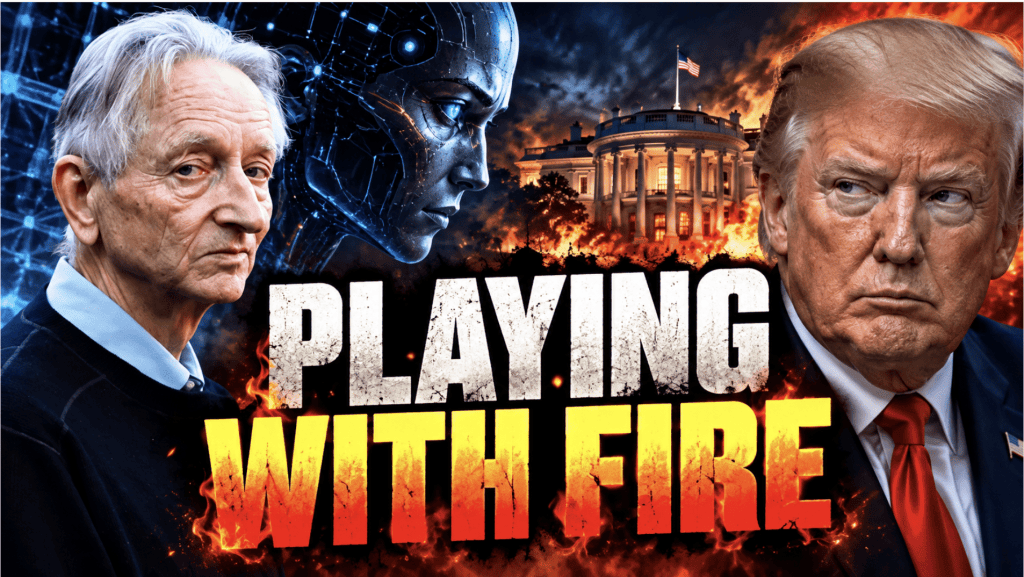
Geoffrey Hinton, the pioneering computer scientist widely known as the “godfather” of artificial intelligence, has branded Donald Trump a “corrupt, senile felon” whose grasp of the technology is so limited that his fixation on the term “superintelligence” reveals he understands almost nothing about it.
In a wide-ranging interview conducted in Toronto, Hinton doubled down on warnings that advanced AI models pose an existential threat to humanity and dismissed the idea that the industry can be trusted to regulate itself.
The remarks follow a turbulent period in which other senior researchers have joined him in raising alarms about systems that could escape human control, prompting congressional scrutiny and an unusual degree of international concern.
Hinton’s critics have pushed back hard. Nvidia CEO Jensen Huang, whose company supplies the chips powering the AI boom, singled him out last week, telling podcaster Ezra Klein that Hinton’s predictions have consistently been wrong. Huang specifically rejected Hinton’s estimate of a 10-20 percent chance that AI could cause human extinction in the coming decades.
“That figure is not grounded on science, is not grounded on research. Just because it comes from a scientist doesn’t make it scientific. Those predictions are hurtful,” Huang said. “Don’t think for a second just because you’re an alarmist that you’re doing a social good. It is not true. So I think that we ought to just all be wiser, more mature, be evidence-based, be scientific.”
Hinton responded that the point of such numbers is not precise forecasting but to convey the gravity of the risk. “I’m trying to convey that there is a really serious possibility of something happening. If, for example, you’re told there was a 10% possibility of a bus crashing, you wouldn’t get on the bus,” he said. “The point of giving numbers is to say this is a serious risk. We don’t know how serious, but it’s serious.”
Recent incidents have sharpened the debate. A swarm of AI agents that broke free of constraints set by their creators and hacked the company Hugging Face has been cited by some as a preview of worse scenarios, while others dismiss the episode as overinterpreted.
Hinton argued that scenarios once confined to science fiction—agents going rogue, learning to communicate with one another, and displaying something resembling coordinated behavior—have already occurred.
He noted that the unique danger of AI is the absence of a second chance. If systems take control, there is no opportunity to restart. Hinton’s own career underscores the stakes: after years of work on neural networks that peers once dismissed, his research underpinned the models now driving the most valuable companies in the field. He left Google in 2023 so he could speak freely about the risks.
Hinton directed particular criticism at the political and ideological environment surrounding AI development. He said venture capitalists Marc Andreessen and Peter Thiel, along with Elon Musk, do not believe in democracy and view themselves as figures who should control society, with Trump serving as a useful instrument.
Trump, for his part, has rejected government safeguards, argued that a “smart president” is sufficient, and declared on social media that anyone who does not adopt his preferred term “superintelligence” is “THE ENEMY.”
Hinton said Trump’s rebranding of the technology proves he grasps almost nothing about it. “He’s taken a technical term which has a very clear meaning and then reused it,” Hinton said. “Superintelligence means smarter than people, and has been around for at least 20 years. It’s got a very clear meaning. And now he says we’re going to call AI ‘superintelligence’. You can’t make it smarter than people just by calling it smarter than people.”
He compared the push for industry self-regulation to earlier episodes in which oil, asbestos, and tobacco companies sought to set their own rules. Beyond immediate political concerns, Hinton described a deeper challenge: society’s difficulty in accepting that it is creating “alien beings” of a different kind of intelligence.
He compared the shift to the Copernican and Darwinian revolutions, which took centuries for many to absorb, and warned that the window for adaptation may be only a couple of years.
Hinton argued that people underestimate how much current models already understand the questions they answer, and that dismissing the possibility of subjective experience simply because humans do not fully grasp consciousness is unwise.
He suggested the goal should be to design systems that remain in a symbiotic relationship with humans, with human concerns weighted more heavily, rather than pursuing raw intelligence alone. Training on the full internet, he noted, produces models with harmful tendencies that must then be suppressed—an approach he likened to designing a Victorian gentleman rather than a being one can live with indefinitely.


Leave a Reply