

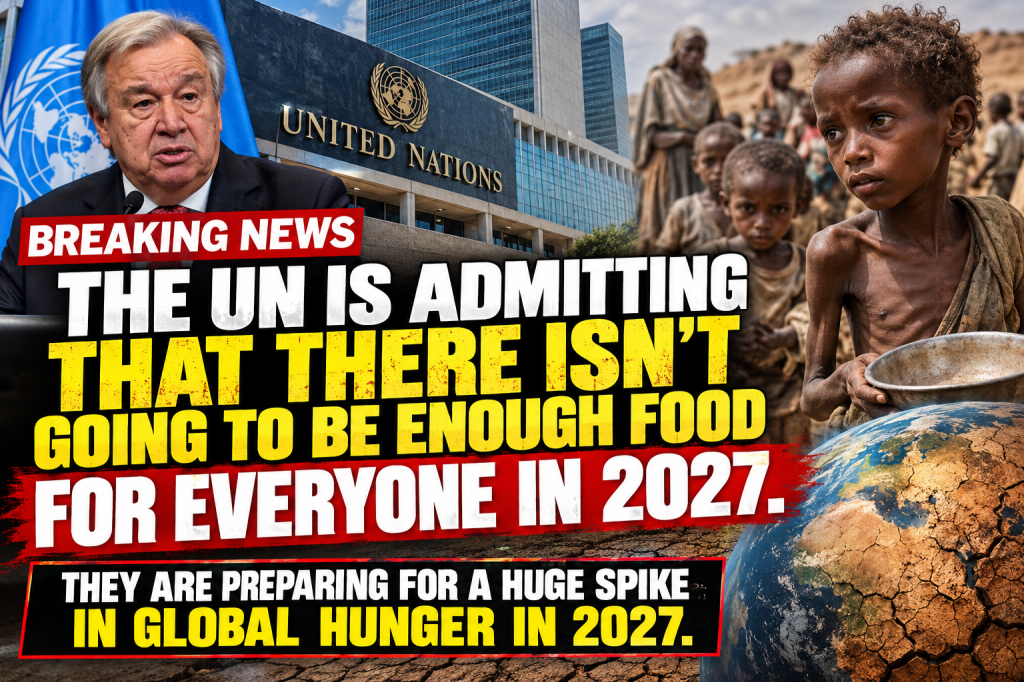
If you think that things are bad now, just wait until food shortages really start to kick in next year. Even the UN is admitting that there isn’t going to be enough food for everyone in 2027. As you will see below, they are preparing for a huge spike in global hunger in 2027. The war in the Middle East has caused a global fertilizer crisis which will produce “thinner harvests” both this fall and next year. At the same time, the soaring price of diesel is putting extreme financial pressure on farmers all over the world. Needless to say, soaring fuel costs will get passed on to the rest of us. On top of everything else, the Super El Niño that I have been writing so much about is causing chaotic weather that is literally wiping out crops in Central America and other parts of the planet. The food that is being harvested now is what is supposed to feed us in 2027, and there simply is not going to be enough of it.
What a disaster 2026 has been.
Coming into this year, there was no war with Iran.
Coming into this year, the Strait of Hormuz was still open.
Coming into this year, there was no Super El Niño.
Coming into this year, the price of diesel was actually quite low.
And coming into this year, we didn’t have a global fertilizer crisis which appears to be having a “catastrophic impact” on global food production…
Six months after the closure of the Strait of Hormuz, the global fertiliser supply chain has collapsed in key regions, creating a dual crisis of physical shortages and soaring costs. Since March, commodity intelligence platform CropGPT has directly surveyed thousands of farmers every month, across eight countries to measure the impacts of the crisis. The data shows a potentially catastrophic impact on global food and beverage – coffee included – supplies and prices in 2027.
CropGPT’s findings reveal that only 43% of farmers surveyed got everything they needed, with farmers in India – which feeds more people than any other country in the world – reporting they have been short of fertiliser for six months. In the Ivory Coast only 6% of coffee farmers were fully supplied in August, while 40% could not get any fertiliser at all. El Nino is forecast to peak just as the effects of fertiliser shortages and thinner harvests come in, multiplying the threat to global agriculture.
CropGPT’s data also unveils a stark economic divide. Where crop prices are strong, such as coffee, farmers have paid more and carried on. Where they are weak, farmers have cut back or stopped buying fertiliser. Farmers who cannot obtain fertiliser face yield loses of up to 50%.
Most people out there have absolutely no idea that this is happening.
They can see that food prices are rising, but they simply do not understand what is ahead of us.
The founder and CEO of CropGPT is ominously warning that the world “cannot absorb a shock of this magnitude without supermarket prices exploding and people starving”…
Commenting on the findings, Rob Weston, founder and CEO of CropGPT, said, “The market is fundamentally mispricing the sheer scale of this crisis. Traders are understandably watching the forecasts to understand the impact of El Niño, but the real catastrophe is already happening on the ground.” He explained that when 57% of farmers across key agricultural regions are reporting they cannot access or afford the fertiliser they need, “we are not just looking at thinner margins, we are facing a global food crisis. Global food systems cannot absorb a shock of this magnitude without supermarket prices exploding and people starving.”
The skeptics can stick their heads in the sand if they wish, but this isn’t going to go away.
Meanwhile, the Super El Niño is expected to reach peak intensity later this year.
The UN’s World Food Program is gearing up for a worst case scenario, because they believe that the Super El Niño will “significantly worsen food insecurity in some of the world’s most vulnerable countries into 2027″…
Analysis from the United Nations World Food Programme (WFP) shows that the strengthening El Niño weather pattern is set to significantly worsen food insecurity in some of the world’s most vulnerable countries into 2027. The agency is ramping up its preparedness and response efforts as impacts from El Niño are already hitting the most vulnerable on the frontlines of hunger.
“El Niño is a massive threat to the food security of millions who are already vulnerable,” said Carl Skau, WFP’s Acting Executive Director. “The sooner we help families to prepare for these climate shocks, the greater our ability to save lives and protect livelihoods. Severe floods and droughts can quickly push communities from coping to crisis. WFP is already ramping-up early response efforts in eight countries, and we stand ready to do even more.”
El Niño is expected to peak between September and December 2026, but in many locations the effects will be felt throughout 2027, due to impacts on future harvest cycles. Drought, flooding and extreme temperatures are already putting communities at risk.
Unless you are really a news hound, you probably aren’t even aware of the nightmare that is currently unfolding in Central America.
Extreme drought has caused “widespread crop failures” in Guatemala, El Salvador and Honduras…
Further north, drought is already taking a heavy toll on Central America’s dry corridor, which stretches across Guatemala, El Salvador, Honduras and Nicaragua. Around 10 million people live in the region, many of them dependent on subsistence farming.
An assessment by Oxfam and humanitarian organisation Action Against Hunger found widespread crop failures across Guatemala, El Salvador and Honduras, with tens of thousands of farming families affected.
Of 73,000 farms that planted maize for the first growing cycle of 2026, around 70,000 reported devastating harvests. Bean crops have also been badly hit and more than 23,000 households reported reduced access to water.
“We are seeing widespread crop losses caused by the drought triggered by El Nino,” said Oxfam’s humanitarian manager for Central America, Ivan Aguilar.
Millions of people in Central America are potentially facing extreme food shortages during the months ahead.
Russian and Ukrainian farmers are facing a different sort of a crisis.
They have been able to produce enough wheat, but it has been exceedingly difficult to get it out of the Black Sea since July.
As a result, Egypt has not “received any Black Sea grain in about a month”…
Connecting Europe and Asia, the Black Sea is a critical conduit for global crop shipments to some of the world’s most populous nations. Russia and Ukraine make up more than a quarter of the global wheat trade, a share similar to the seaborne oil trade passing through Hormuz in the Gulf.
Supplies have been choked off since July when the countries stepped up attacks on each other’s ports, pummeling grain terminals, silos and vessels. The escalation also hit Russia’s energy infrastructure, sending diesel prices to records. A key input into farming, the cost of the fuel is another inflationary risk for food.
Egypt, the world’s biggest wheat buyer, hasn’t received any Black Sea grain in about a month. Russia’s exports are throttled by Ukrainian drones, while Ukraine, with its ports blocked, is struggling to get its grain out by land or river. As harvests pile up, the country is also struggling to find enough storage.
Egypt imports approximately 50 percent of the wheat that it consumes.
Other nations in the Middle East are similarly dependent on wheat from Russia and Ukraine.
If something doesn’t change, there will soon be an enormous number of very hungry people.
In wealthy western countries, crippling summer droughts have resulted in “shriveling harvests”…
Droughts across the US and Europe have been shriveling harvests, and weather forecasts for a “super” El Niño this year means “there are some alarming signals” about the impact of weather on wheat crops, said Joao Lampreia, a market strategist at the Lisbon-based Freedom24.
What we are witnessing is far more serious than most people realize.
Here in the U.S., the latest wheat production numbers are downright gloomy…
The smallest U.S. wheat crop in decades continues to shrink.
The USDA now has combined production at 1.531 billion bushels, 5 million less than July, due to cuts in winter wheat acreage and non-durum spring wheat yield projections. Winter and spring wheat production numbers were both down from a month ago, at 989.89 million and 474.3 million bushels, respectively. If realized, this would be the smallest combined U.S. winter wheat crop since 1963. Combined production for all types of wheat in 2025 was 1.985 billion bushels.
We aren’t producing enough wheat.
We aren’t producing enough rice either.
In fact, Zero Hedge is reporting that “America’s rice harvest is forecast to fall to its lowest level in 33 years”…
America’s rice harvest is forecast to fall to its lowest level in 33 years. CBOT rough rice futures, the benchmark for US long-grain rice before milling, are surging higher at the end of summer after rising 69% so far this year.
USDA forecasts total production at 158.2 million hundredweight, roughly 23% below last year’s 206.7 million. Harvested acreage is projected at just 2.057 million acres, the lowest since the 1972/73 season.
“While beginning stocks are raised 4.6 million cwt to a 40-year high of 58.4 million cwt, production is reduced 0.2 million cwt to 158.2 million, a 33-year low, as a reduced forecast for harvested area more than offsets a higher yield,” USDA wrote in a report.
Oh, by the way the size of the U.S. cattle herd has fallen to its smallest size in 75 years.
Everywhere you look, there is more bad news, and now the price of diesel is skyrocketing.
CBS News recently interviewed 52-year-old North Carolina farmer Matt Bell, and he explained how the rising price of diesel is financially crushing his farm…
Prices have been so volatile that Bell said the price he’s quoted from his distributor in the morning is only valid until the afternoon — when it rises again. He can’t avoid the expense — his farm equipment runs on diesel. Bell showed CBS News his combine, which he says now requires about $600 worth of diesel fuel per day. That’s more than twice what he paid last year.
Bell said he blew through his yearly fuel budget of $35,000 in August. Now, he expects his total for the year to be closer to $50,000 to $60,000.
“Every piece of equipment on this farm runs on diesel,” he said. Without it, his farm wouldn’t be able to function.
Without our farmers, we do not eat.
And without diesel, our farmers cannot operate.
At this stage, Bell admits that he is more stressed out than he has ever been before…
“I’ve done this 34 years. I have never worried and stressed like I have the last year,” Bell told CBS News in an interview on Wednesday at his farm in Kings Mountain, North Carolina.
Bell has been forced to make significant changes to his operation as a result of the high costs. He’s shifting some of his acreage, trying to stretch out the lifespan of his equipment and producing his own fertilizer. His children have also opened up a storefront where visitors can pick pumpkins and take hayrides in the fall. But Bell is still feeling the pinch.
“We’ve cut everything we can cut,” he said. “The last several years in agriculture have been terrible, and we have, you know, just cut the fat anywhere we could. But we’re just getting to the point now there’s nothing left to cut. You cannot run without fuel. You cannot run without fertilizer. You have to have that.”
Sadly, if World War 3 continues to intensify it is likely that diesel prices will go a lot higher.
What will we do then?
In the Midwest, fuel surcharges are already going through the roof…
The fuel shock is especially significant across the Midwest, where corn and soybean harvest generates intense demand for combines, tractors, grain trucks and commercial transportation. Midwest diesel averaged $6.250 per gallon on September 14, up from $5.946 just one week earlier, while the national average increased 31.8 cents over the same period. Compared with a year earlier, U.S. diesel was $2.546 per gallon more expensive. That increase affects far more than the fuel line in a farm budget: it raises the cost of operating equipment and moving fertilizer, seed and other inputs while increasing the expense of transporting harvested grain.
Rail freight shows how rapidly those higher energy costs are moving through the agricultural supply chain. Union Pacific’s standard mileage-based fuel surcharge stood at 28 cents per mile in July 2025 but reached 71 cents in July 2026. For October, the railroad has set the surcharge at 68 cents per mile, compared with 33 cents in October 2025 – an increase of roughly 106% year over year. The October charge is based on an August 2026 highway diesel average of $5.462 per gallon. For grain shippers, elevators and co-ops that depend heavily on rail, the surcharge becomes another expense that must ultimately be absorbed somewhere between the farm gate and the final customer.
Diesel prices are also having an enormous impact on the trucking industry.
Earlier today, I was stunned to learn that 16 trucking companies have filed for bankruptcy in less than a month…
A new round of trucking bankruptcies has swept across the U.S. in recent weeks, with carriers ranging from small owner-operators to fleets operating dozens of trucks seeking Chapter 7 or Chapter 11 protection.
At least 16 trucking, delivery and transportation companies entered bankruptcy proceedings between late August and Sept. 21, according to federal court filings and carrier records reviewed by FreightWaves.
The filings include Chapter 11 cases involving Globemaster Incorporated, Xoco Transport, Jett Transport & Materials, CLJ Transporting, Mill Creek Logistics-Illinois, RP Hay Hauling, Truckload LLC and Pacer Transport. Several smaller carriers filed Chapter 7 cases, which typically involve liquidation rather than reorganization.
This is what a “perfect storm” looks like, and we are still only in the early stages.
There will be food shortages in impoverished countries all over the globe in 2027.
In wealthy countries, food prices are already ridiculously high, but they will soon go even higher.
We have got an unprecedented global food crisis on our hands, and there is no relief in sight for the foreseeable future.
Michael’s new book entitled “10 Prophetic Events That Are Coming Next” is available in paperback and for the Kindle on Amazon.com, and you can subscribe to his Substack newsletter at michaeltsnyder.substack.com.


Leave a Reply