

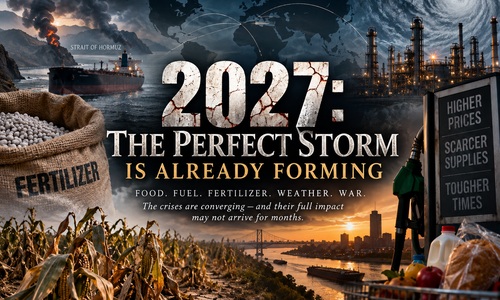
Most Americans aren’t thinking about sulfuric acid, phosphate fertilizer, Saudi oil pipelines or water levels on major shipping routes when they walk through the grocery store.
But perhaps they should be.
A remarkable collection of problems is developing across the systems that produce and transport the things Americans use every day. War is disrupting energy and fertilizer markets. Saudi oil infrastructure has been attacked. A major Midwestern refinery is offline. Fertilizer supplies have been squeezed. An exceptionally powerful El Niño is developing.
Any one of these problems can usually be absorbed.
The concern is what happens when several hit together—and when the consequences of today’s disruptions don’t fully appear until 2027.
That is the perfect storm now taking shape.
Why A Crisis Thousands Of Miles Away Can Reach Your Grocery Cart
Start with the Strait of Hormuz.
To the average American, it sounds like another distant Middle Eastern shipping lane. In reality, what happens there can eventually affect everything from the cost of filling a pickup truck to the price of bread.
The Strait normally carries enormous volumes of oil, natural gas, sulfur and fertilizer products. The UN Food and Agriculture Organization warned in May that disruptions there were already tightening fertilizer markets and increasing energy costs, with consequences that could extend into 2027.
Here’s the connection.
Modern farms require fertilizer. Producing and transporting fertilizer requires energy. Farmers require diesel to plant and harvest crops. Trucks, trains and ships then require fuel to move those crops. Food processors require energy. Finally, trucks require still more diesel to deliver food to supermarkets.
Increase the cost or reduce the availability of several of those inputs simultaneously and the consumer eventually pays for it.
But not immediately.
That delay may be one of the most important parts of this story.
The Fertilizer Clock Is Already Ticking
Unlike many manufactured products, agriculture can’t simply make up lost production next Tuesday.
Crops have planting windows. Fertilizer has application windows. Harvests happen on biological schedules.
The FAO has made precisely this point, warning that fertilizer arriving several weeks late can force farmers to use less of it or miss the application entirely. The result can be lower yields months later. Its warning specifically extends into 2027.
That creates an unsettling chain reaction:
Expensive or unavailable fertilizer today can mean less fertilizer applied to a field.
Less fertilizer can mean a smaller harvest.
A smaller harvest means tighter supplies.
Tighter supplies can mean higher prices for grain.
Higher grain prices eventually work their way into cereal, bread, meat, dairy and countless processed foods.
The original disruption may have happened half a world away months earlier.
The American family simply encounters the final result at checkout.
Read More: https://www.prophecynewswatch.com/article.cfm?recent_news_id=10522


Leave a Reply