

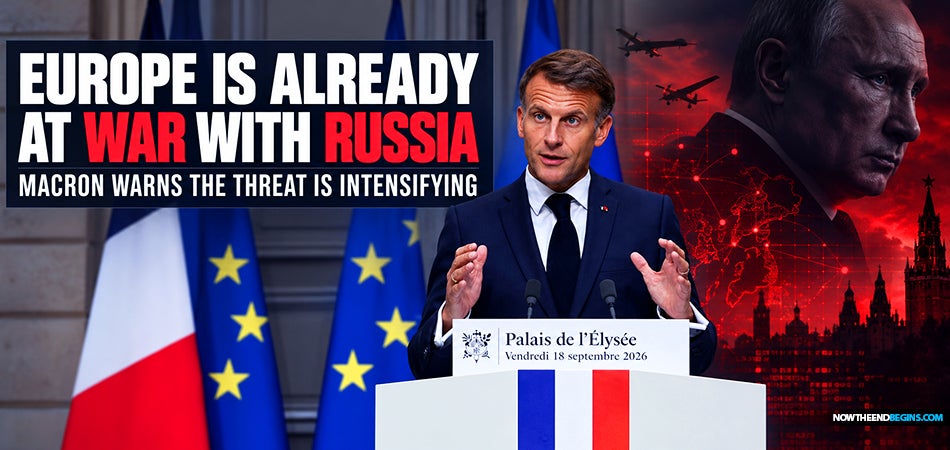
French President Emmanuel Macron has issued one of his strongest warnings yet that Russia’s war against Europe is no longer confined to the battlefield in Ukraine. According to Macron, the Russian hybrid threat has intensified through drone incursions, cyberattacks, sabotage, disinformation and interference in the political systems of European nations. These are not the opening scenes of some hypothetical future conflict—they are the weapons of a shadow war already being waged across the continent. Russia is testing European defenses, probing critical infrastructure and attempting to discover exactly how much pressure NATO will tolerate before responding. Macron’s Nicolae Carpathia moment is waiting on deck.
“And through his policy also he shall cause craft to prosper in his hand; and he shall magnify himself in his heart, and by peace shall destroy many: he shall also stand up against the Prince of princes; but he shall be broken without hand.” Daniel 8:25 (KJB)
Macron’s announcement followed a rare crisis meeting at the Élysée Palace where French intelligence chiefs briefed political leaders and presidential candidates about threats flowing from the wars in Ukraine and Iran. This wasn’t just another campaign speech or routine diplomatic gathering. France assembled its intelligence establishment and political class to prepare the country for a rapidly deteriorating international situation. Macron then ordered his government to develop plans to protect critical infrastructure and sensitive defense-industry facilities from drones and cyberattacks. Europe is quietly moving from supporting somebody else’s war to preparing its own territory for attack.
The danger is that Russia’s hybrid war exists deliberately below the threshold of a conventional NATO conflict. A missile launched against Paris would produce an unmistakable response; a mysterious drone over a weapons factory, a paralyzed power grid, a sabotaged railway or a carefully orchestrated disinformation campaign creates uncertainty. Who launched it? Was it intentional? Does it justify invoking Article 5? Moscow can damage, intimidate and divide Europe while forcing NATO to debate whether it has technically been attacked. That hesitation is not a weakness in Russia’s strategy—it is the entire strategy. Meanwhile, this security crisis is merging with an economic crisis. Macron connected Europe’s surging energy prices with the wars in Ukraine and the Middle East and the disruption of shipping through the Strait of Hormuz. He plans to convene a G7 meeting to discuss energy cooperation and the possible release of strategic reserves. That means France is now confronting Russian pressure from the east, Iranian and Houthi pressure on global shipping from the south, and growing anger from families watching energy bills devour their incomes at home. The wars are no longer distant television images; they are entering European homes through utility bills, inflation and taxes.


Leave a Reply