

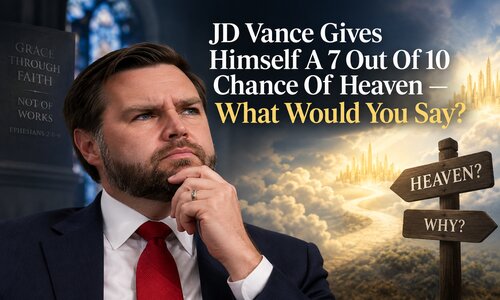
Vice President JD Vance was recently asked a question that has nothing to do with elections, economics or foreign policy.
“On a scale of one to ten, how confident are you that you would go to heaven?”
Vance paused before answering.
“It’s high, but it’s not a 10. I mean, it’s a seven or it’s an eight.”
The question came during an interview with young Christian evangelist Bryce Crawford. Vance explained that part of his uncertainty comes from occasional doubts about whether Christianity is actually true and whether there really is something beyond this life. A year earlier, he said, his answer might have been only a five or six.
Vance nevertheless made something else very clear: “I believe in Jesus Christ. I believe he’s my Savior.”
For Christians, his answer raises a question far more important than what the vice president believes.
What would you say?
And perhaps more importantly: Why?
The Question Behind The Question
Crawford explained that he once would have answered the same question with a six because he was looking at himself.
He knew his failures. He knew his sins. He wondered whether he had done enough.
Then a pastor challenged his thinking with a simple question: Did Jesus die for only 60 percent of your sins?
That gets remarkably close to the heart of the Protestant understanding of the Gospel.
Our confidence before God does not rest upon how well we have performed. It rests upon what Christ has already accomplished.
Paul writes that we are “justified freely by his grace through the redemption that is in Christ Jesus” (Romans 3:24). Ephesians 2:8-9 declares that salvation is by grace through faith, “not of works, lest any man should boast.”
Philippians 3:9 makes the distinction even clearer. Paul wanted to be found in Christ, “not having mine own righteousness, which is of the law,” but possessing the righteousness that comes through faith in Christ.
In other words, the question isn’t ultimately:
How confident are you in yourself?
It is:
How confident are you in Christ?
Catholicism And Protestantism Part Ways
This becomes particularly interesting because Vance is Catholic. He converted to Roman Catholicism in 2019 after having earlier identified with evangelical Protestantism.
The Catholic Catechism describes justification as a freely given act of God and grace as God’s gratuitous gift. It specifically teaches that no person can merit the initial grace that brings conversion and justification.
But that isn’t the end of Catholic teaching.
The Catechism also teaches that justification involves man’s cooperation with grace and that, after receiving grace, Christians can acquire “merit” through their union with Christ. It goes so far as to teach that, moved by the Holy Spirit, believers can merit graces necessary for sanctification and “the attainment of eternal life.”
This is precisely where Protestants should stop and examine Scripture carefully.
The issue isn’t whether good works matter. They certainly do.
The issue is what role those works play in our standing before God.
Read More Here: https://www.prophecynewswatch.com/article.cfm?recent_news_id=10456


Leave a Reply