

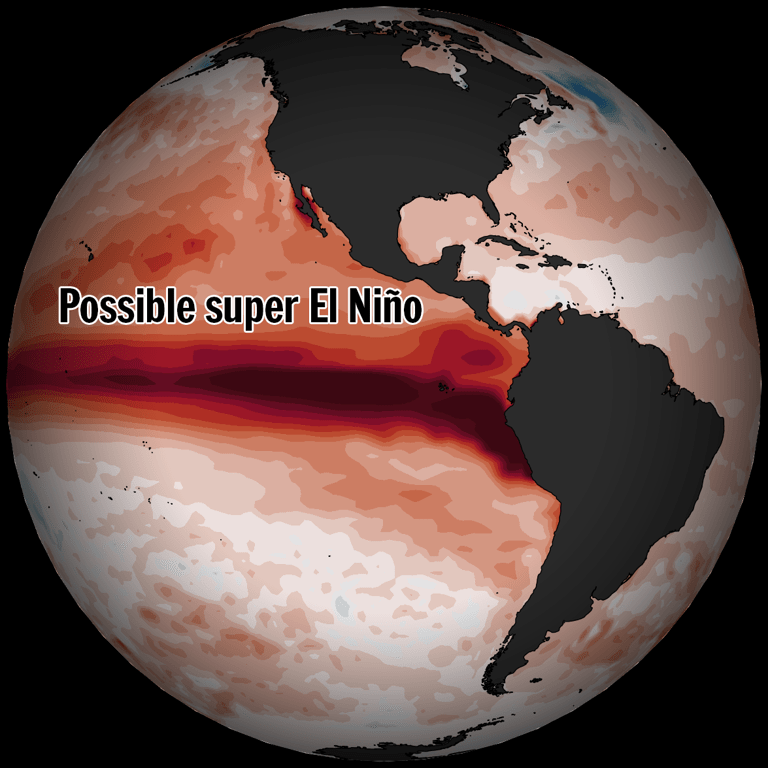
The chances for a planet-warming super El Niño this year are rising, according to an updated model forecast issued Sunday.
The latest ECMWF outlook indicates there’s a high chance for a supercharged version of the climate pattern that affects regional-to-global weather patterns this summer or fall, doubling down on a super El Niño prediction from last month.
During a typical El Niño, a warming patch of water in the equatorial Pacific Ocean influences what regions experience droughts, floods, extreme heat, hurricanes and declining sea ice. During relatively rare super El Niño events, happening once every 10 to 15 years on average, the effects may be stronger, more persistent and more widespread.
That’s because sea temperatures in that key region of the Pacific Ocean warm more than 2 degrees Celsius (3.6 degrees Fahrenheit) above average, leading to a strong atmospheric response — typically peaking in December or January.
For example, the Western United States, parts of Africa, Europe and India could face a hotter-than-average summer, some tropical countries, such as those in the Caribbean and Indonesia could face worse drought and extreme heat, while more tropical cyclones could develop in the Pacific, with fewer in the Atlantic.
This possible super El Niño could also push global temperatures to record levels, particularly in 2027, and have agricultural impacts as weather patterns change.
“Real potential for the strongest El Niño event in 140 years,” wrote Paul Roundy, a professor of atmospheric science at the State University of New York at Albany.
Global impacts from a super El Niño
This year’s potential super El Niño seems increasingly likely to have wide-reaching climate impacts that last into 2027.
It could break the record for El Niño intensity set in December 2015, when sea temperatures in the central equatorial Pacific reached 2.8 degrees Celsius (5.04 degrees Fahrenheit) above average.
Still, even as some signs point to a potent event, including a rare triplet-cyclone pattern brewing in the Pacific, uncertainty remains as to how strong this year’s El Niño will become. Furthermore, no two El Niño events are alike — especially as the climate warms — but past experiences can be used to help plan and prepare.
Here are some of the weather impacts predicted to unfold through at least October, according to the newest model outlook.


 END TIMES PROPHECY WATCH
Leave a comment