

It always begins with a promise.
A promise of convenience.
A promise of safety.
A promise of efficiency.
A promise that this new system will make life easier, smoother, smarter, more secure.
But history has taught us something governments and global elites rarely admit: the most dangerous systems of control are almost never introduced as tools of oppression. They are introduced as tools of progress.
That is exactly what we are watching unfold right now with the worldwide push for digital ID.
What is being sold to the public as modernization is, in reality, the construction of something far more powerful and far more dangerous: a system capable of tying your identity, your finances, your communications, your health records, your employment, and eventually your access to society itself into one trackable, manageable, enforceable framework.
Call it digital identity.
Call it digital public infrastructure.
Call it modernization.
But at its core, it is the architecture of control.
And increasingly, some of the most influential voices in the world are no longer hiding just how expansive they want that architecture to become.
Bill Gates has once again championed digital identity as a foundational pillar for the future in a recent discussion, openly describing a framework that begins with identity, bank accounts, and payments — and then expands outward into agriculture, health records, and even climate policy.
That should stop people in their tracks.
Because once identity is tied to your money, and then connected to your medical history, your food systems, your land use, your energy consumption, and your compliance with state or institutional rules, you are no longer dealing with a simple ID card. You are dealing with a digital leash.
And this is not the first time Gates has promoted such a vision.
In 2022, the Bill & Melinda Gates Foundation argued that digital ID, digital payments, and interoperable data-sharing should function together as the three “foundational systems” of what it calls digital public infrastructure. That may sound technical and harmless, but the implications are enormous. In plain language, it means creating a society where proving who you are digitally becomes the gateway to participating in everyday life — whether that means getting paid, receiving benefits, opening a bank account, accessing health care, or interacting with the government.
Then in 2024, Gates expanded on that same worldview, again praising systems that combine digital identity, payment rails, and interoperable records as a model for the future.
And even earlier, in 2018, he publicly praised India’s Aadhaar system — one of the largest biometric identity programs in the world — and brushed aside privacy concerns. That praise now looks especially troubling, given the years of controversy surrounding Aadhaar over surveillance fears, exclusion, and data vulnerabilities.
That is the deeper issue here: digital ID never stays in its original lane.
It is never just for “verification.”
It is never just for “security.”
It is never just for “convenience.”
Once governments and institutions have a durable, biometric-linked identity system, the temptation to connect it to everything else becomes overwhelming.
Banking.
Health care.
Employment.
Taxes.
Travel.
Welfare.
Education.
Telecommunications.
Licensing.
Public benefits.
Access to digital services.
Authentication for everyday life.
That is not paranoia. That is the natural logic of the system.
And perhaps no country illustrates that danger more clearly right now than Mexico.
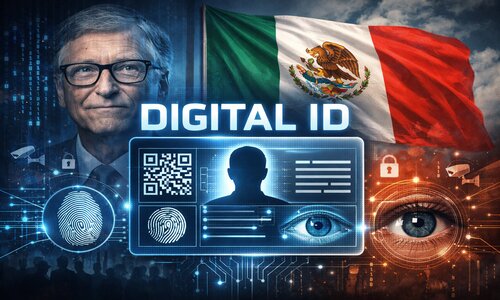
Mexico is rolling out what is known as the CURP Biométrica, a major expansion of its existing population registry. What was once an 18-character alphanumeric identity code is being transformed into something much more invasive and much more personal.
Under this new system, the government collects fingerprints, iris scans, facial photographs, and a digital signature, packaging all of that into a QR-enabled identity credential tied directly to your body.
This is not simply a paper ID digitized. This is your biological identity being absorbed into a state-managed system.
To register, citizens must go to RENAPO and Civil Registry offices, where staff scan all ten fingerprints, both irises, take a facial image, and record a digital signature. They must also provide a valid photo ID, a certified CURP, and an original or certified birth certificate just to complete the process.
The Mexican government has framed this expansion primarily as a response to the country’s devastating crisis of forced disappearances. That is the emotional justification being offered. Officials say the system will help identify missing persons and improve coordination between databases.
But the actual structure being built goes far beyond that stated purpose.
The biometric data is being fed into a Unified Identity Platform that links the National Population Registry with the National Forensic Data Bank and records held by prosecutors, intelligence agencies, and other government bodies. In other words, this is not merely a missing persons tool. It is an integrated state identity system with wide surveillance potential and broad institutional access.
And here is the part many people will miss unless they look closely: the law reportedly does not require authorities to notify citizens when their data is accessed.
So if law enforcement, intelligence agencies, or the National Guard pull your biometric or personal information, you may never know. You will not know who looked. You will not know why. You will not know how often. And you will have little meaningful ability to challenge it.
That should terrify any society that still claims to value civil liberty.
But the coercive element in Mexico becomes even more alarming when you look at what is happening with mobile phones.
By July 2026, every one of Mexico’s roughly 130 million mobile phone lines must be linked to a biometric-backed national identity credential. Existing mobile lines must be brought into compliance by June 30, and beginning July 1, unregistered numbers are subject to suspension.
Think about what that means in practical terms.
You can say the system is “voluntary” all you want. But if refusing to enroll means losing your phone, then it is not voluntary at all.
It is coercion.
That includes prepaid and postpaid lines, physical SIM cards and eSIMs. Carriers are required to verify subscriber identity against the national system. Anonymous or privately held mobile access — something that has long mattered for journalists, abuse survivors, political dissidents, whistleblowers, and ordinary privacy-conscious citizens — is being steadily erased.
And this is not even Mexico’s first attempt at doing this.
It is the third.
Mexico’s first cell phone registry, RENAUT, was launched in 2008 and required users to register their numbers with their CURP. It quickly became a scandal. Within months, private data from millions of users was reportedly leaked and even allegedly sold. The program was abandoned by 2012.
Then came PANAUT, a second attempt that expanded toward biometric registration, including fingerprints and facial recognition. Civil liberties advocates and digital rights groups challenged it, and in 2022 Mexico’s Supreme Court struck it down as unconstitutional, citing privacy and rights concerns.
Now, just a few years later, the same basic idea is back — only bigger, more invasive, and tied into a much larger government identity ecosystem.
That should be one of the biggest warning signs of all.
When governments fail with centralized identity databases, the damage is not minor. If your password leaks, you can change it. If your credit card is compromised, you can cancel it.
But if your fingerprints leak?
If your iris scans are copied?
If your facial biometrics are compromised?
You cannot reset your body.
That is the irreversible danger of biometric identity systems. Once your biological markers are collected, digitized, and networked, the stakes are permanent.
And this is not just a Latin American story.
The United Kingdom is moving in the same general direction.
In Britain, digital identity is increasingly being pushed into the world of work. The UK government has announced plans to make digital right-to-work checks mandatory by the end of Parliament, meaning employment verification is moving toward a system where legal work status is increasingly tied to digital identity compliance.
That may sound bureaucratic and harmless at first glance, but it carries enormous implications.
Because once the ability to work is tied to a digital verification structure, “voluntary” identity systems quickly become functionally mandatory.
You may not technically be forced to sign up.
But if you cannot get hired without it, what exactly is the difference?
That is one of the most deceptive aspects of digital ID policy around the world. Governments often avoid the politically explosive move of saying, “You must enroll.”
Instead, they simply build a society where opting out becomes practically impossible.
You can refuse — but then you lose your phone.
You can refuse — but then you struggle to work.
You can refuse — but then you cannot access services.
You can refuse — but then you are locked out of modern life.
That is not freedom. That is managed compliance.
And beyond Mexico and the UK, there are at least two more major global examples that reveal just how broad this push has become.
The first is India.
India’s Aadhaar system is frequently celebrated by global technocrats as a model for digital governance. It is one of the largest biometric identity systems ever created, and it has become deeply embedded in everyday life.
Supporters say it improves access and efficiency. But critics have long warned that when a biometric identity system becomes the key to financial services, telecoms, government benefits, and public access, it creates a society where exclusion, surveillance, and dependency become structural features of the system itself.
Aadhaar is often presented as a success story. But it is also a warning.
Because once identity becomes the access layer for modern life, errors become catastrophic, privacy becomes fragile, and centralized power becomes normalized.
The second example is the European Union.
The EU’s Digital Identity Wallet is being marketed as secure, convenient, and citizen-friendly. On paper, it is “voluntary.” But the direction is unmistakable: a continent-wide digital identity framework designed to authenticate citizens across services, records, documents, and interactions.
That may sound sleek and futuristic. But it also raises the exact same civil liberties concerns seen elsewhere.
When one digital identity framework begins to touch banking, records, government services, credentials, and cross-border interactions, it creates the possibility of transaction linkability, profiling, behavioral mapping, and mass data correlation at an unprecedented scale.
And once such systems become normalized, they rarely shrink. They expand.
That is the lesson every free society should remember.
Because digital ID is not just about proving who you are.
It is about creating a control layer over life itself.
It enables transaction traceability, where your spending and financial behavior can be linked to your identity.
It enables behavioral profiling, where your health, work, communications, travel, and records can be connected into one comprehensive profile.
It enables conditional access, where institutions can increasingly decide whether you are approved, flagged, delayed, or denied.
It enables automated exclusion, where a bureaucratic error, expired credential, mismatch, or algorithmic decision can suddenly lock you out of essential services.
And it enables surveillance at scale, because once all major databases are tied together through a single identity spine, governments no longer need old-fashioned mass surveillance in the way people once imagined it.
They do not need someone following you on every street corner.
They simply need the system.
A system that knows who you are.
A system that knows where you bank.
A system that knows how you communicate.
A system that knows where you travel.
A system that knows what services you use.
A system that can increasingly decide what you can access.
That is why this issue matters so much more than many people realize.
This is not just a technology debate.
It is not just a policy debate.
It is not just a paperwork debate.
It is a freedom debate.
Because the deeper question beneath all of this is simple:
Will citizens remain free human beings with rights — or will they become permissioned users inside a digitally managed system?
That is the future being built right now, piece by piece, country by country, policy by policy, database by database.
And the public is being told it is all for their own good.
But if your face becomes your password,
your fingerprints become your access key,
your phone becomes a state-linked identity node,
your bank account becomes tethered to your digital profile,
and your ability to work depends on digital verification,
then freedom has not been strengthened.
It has been redesigned.
And in the process, it may be quietly disappearing.


 END TIMES PROPHECY WATCH
Leave a comment