

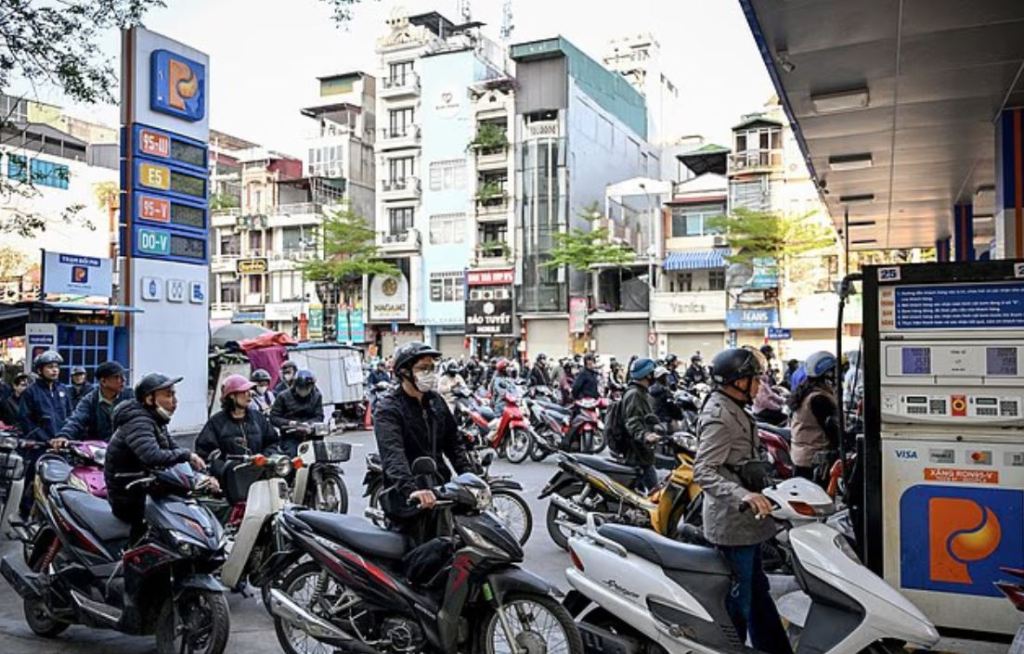
Countries around the world are scrambling to save fuel as the vital oil pathway of the Strait of Hormuz remains at a standstill.
The escalating war with Iran has pushed oil prices above $100 a barrel, despite pleas from global leaders for Tehran to unblock the waterway.
Sri Lanka has ordered street lights, neon signs and billboard lighting to be switched off from Tuesday as part of measures to cut energy consumption by 25 per cent to tackle supply shortages.
Government spokesman Nalinda Jayatissa said all state institutions had been asked to reduce the use of air conditioning as the Middle East war entered its fourth week, driving up oil and gas prices.
Sri Lanka has already raised fuel prices by a third since the United States and Israel began bombing Iran, triggering retaliatory attacks that have disrupted global energy supplies.
‘We need to reduce consumption by at least 25 per cent,’ Mr Jayatissa told reporters in Colombo.
‘We hope the private sector too will abide by the guidelines drafted by a panel of experts.’
The island has introduced a four-day work week and brought back work-from-home arrangements since last week, to reduce pressure on the transport network.
The minister said the new measures include switching off advertising illumination after 9.00pm and all street lights, except in high security areas.
An energy ministry official said peak demand was being met with coal and diesel, and that the island faced a risk of nationwide power cuts unless consumption was drastically reduced.
Last week, president Anura Kumara Dissanayake urged electric car owners to avoid overnight charging, saying the resulting demand surge of 300 megawatts had forced the country to burn more coal and diesel to maintain the grid.
About half of Sri Lanka’s electricity is generated by coal and diesel. The country has yet to install battery storage for renewable energy, which is in surplus during the day.
It comes as the president of the Philippines declared a state of national energy emergency in response to the Middle East conflict and what he called an ‘imminent danger’ posed to the country’s energy supply.
On Tuesday, president Ferdinand Marcos Jr said the conflict had created uncertainty in global energy markets, severe supply chain disruption and significant volatility and upward pressure on international oil prices ‘thereby posing a threat to the country’s energy security.’
‘The declaration of a state of national energy emergency will enable the government … to implement responsive and coordinated measures under existing laws to address the risks posed by disruptions in the global energy supply and the domestic economy,’ he said.
The declaration, which will remain in effect for one year, authorizes the government to procure required fuel and petroleum products to ensure timely and sufficient supply and, if necessary, pay part of the contract amount in advance.


 END TIMES PROPHECY WATCH
Leave a comment