

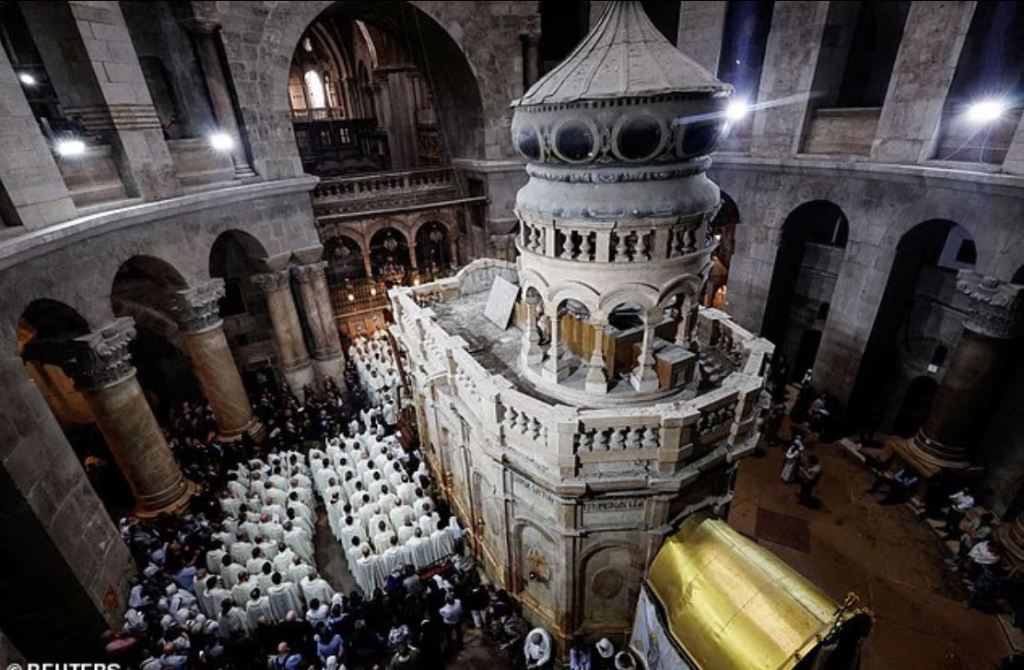
The closure of the Church of the Holy Sepulchre during Holy Week has sparked fears that biblical prophecies about the Antichrist may be coming to pass.
Constructed under Roman Emperor Constantine, the nearly 1,700-year-old shrine is believed to mark the site of Jesus’ crucifixion, burial and resurrection.
Thousands of worshippers and tourists visit the site during Holy Week, with attendance for the Holy Saturday Holy Fire ceremony often reaching 10,000 in peak years.
Iranian ballistic missiles have exploded over Jerusalem, scattering debris across multiple areas of the city, including near the Church of the Holy Sepulchre, forcing Israeli officials to close the sacred doors indefinitely, along with access to all holy sites in the region.
While the unprecedented move was a result of war, some observers have pointed to passages in the Book of Revelation that describe a period of upheaval and persecution in the final days, specifically ‘where also their Lord was crucified.’
In Revelation 11, the text describes two prophetic witnesses who preach in a holy city before being killed by a powerful figure known as the ‘beast,’ often interpreted by some as the Antichrist.
The Antichrist is a figure in Christian theology believed to be a powerful deceiver who will oppose Jesus Christ and lead many people away from the faith before the end of the world. The passages also speak of the city being ‘trampled’ for a set period, alongside widespread fear, destruction and divine judgment.
Though the scripture does not refer to any specific modern location or event, some see parallels in the disruption of worship at one of Christianity’s most sacred sites, particularly during one of its holiest weeks.


 END TIMES PROPHECY WATCH
Leave a comment