

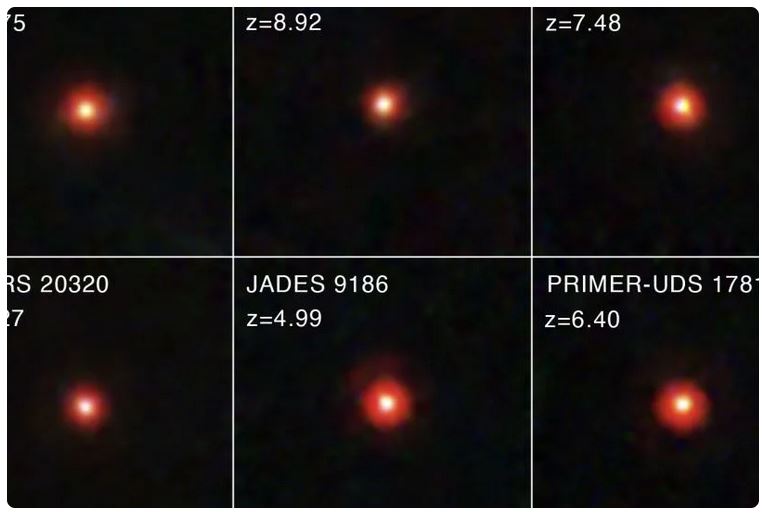
Like tiny photobombers, cosmic anomalies resembling small, bright red points show up in almost every snapshot taken by the most powerful space telescope ever made. Astronomers now call them little red dots, or LRDs, but there is no agreement yet on what exactly they are.
Since NASA’s James Webb Space Telescope started peering into the universe four years ago, hundreds of the puzzling objects have appeared in its images. Their unknown origins effectively launched a scientific case that hundreds of studies have attempted to crack.
“This is the first time in my career that I have studied an object where we truly do not understand why it looks the way it does,” said Jenny Greene, a professor of astrophysical sciences at Princeton University. “I think it’s fair to call them a mystery.”
One thing was clear from the beginning — these strange objects were common. “Every deep pointing you did with James Webb, you were finding a few,” said Greene, referring to the action of focusing the telescope on the same patch of sky for an extended time to collect extremely faint light.
Initially, some astronomers suggested the dots could be massive galaxies from the early universe, or black holes surrounded by dust. However, these initial assumptions were later upended by further observations, paving the way for several new hypotheses, many of them still involving black holes.
“I certainly think they’re powered by growing black holes, but there are other, more exotic suggestions, like some kind of very massive star dying,” Greene said. An expert in supermassive black holes and galaxy evolution, she explained that she believes a black hole as the main component of LRDs fits the largest number of the observations made of the objects so far.
However, she added, someone could make an entirely new observation that overturns every assumption about what LRDs are. “So far, that’s what’s happened. We’ve had an expectation, it’s been wrong. We’ve had another expectation, it’s been wrong. So I would leave that possibility open still.”
Whether these curious dots ultimately confirm older theories or represent a novel discovery, scientists are set to gain a new understanding of the universe.
A ‘missing link’
The name little red dots first appeared in a 2024 study, almost two years after scientists had begun studying the objects. The moniker was coined by Jorryt Matthee, head of the research group on the astrophysics of galaxies at the Institute of Science and Technology Austria, who chose it because it was simpler and catchier than the more scientifically accurate term: “broad-line H-alpha emitters.”
The reason astronomers only spotted LRDs after Webb came online is that other telescopes in operation at the time, like Hubble, didn’t have enough resolution or lacked the sensitivity in the longer infrared wavelengths, beyond the threshold of visible light, to see them. But the Webb telescope, with its 21.6-foot-wide (6.5-meter-wide) primary mirror, has revealed objects that were previously hidden.
The dots appear red because they are so far away, and as the universe expands, light from extremely distant objects gets stretched into the infrared as it travels to reach Earth — a phenomenon astronomers call “redshift.”
But the dots are also inherently red, although the exact reason why is one of the trickiest parts of the puzzle.


 END TIMES PROPHECY WATCH
Leave a comment