

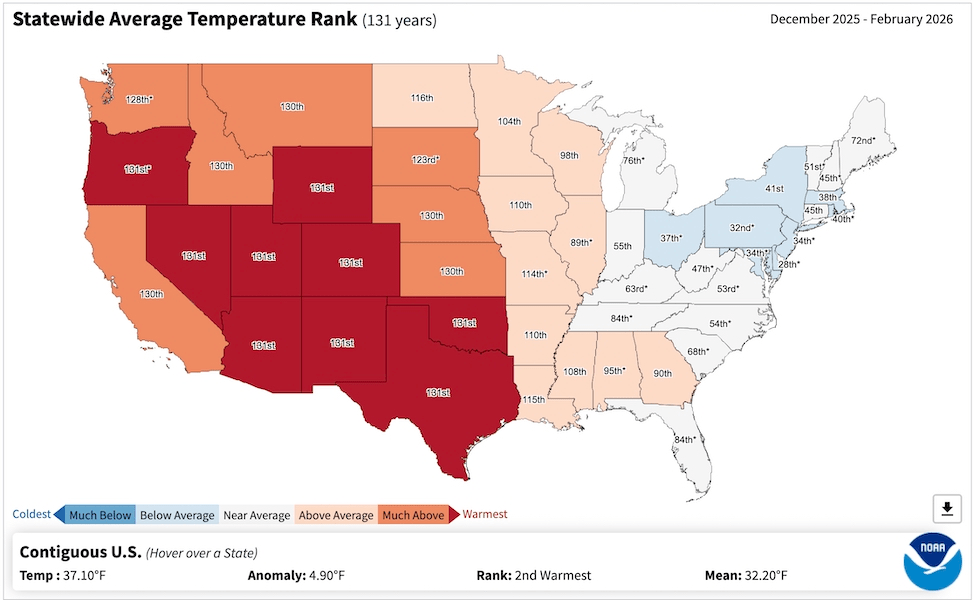
People who are still thawing out from the Midwest to the mid-Atlantic may be wondering: How bad a winter was this for the nation as a whole? The answer: very bad – if you’re concerned about long-term warming and intensified drought impacts, that is.
Winter 2025-26 (December through February) was the second-warmest in U.S. records going back to 1895. The average temperature for the contiguous states was 37.13 degrees Fahrenheit, according to the monthly roundup released on March 9 by NOAA’s Climate Prediction Center. Given that the warmest winter on record was 2023-24, with 37.47 degrees F, the two warmest U.S. winters in 131 years of data have now occurred in the last three years.
It’s true that many parts of the northeastern half of the country, roughly from the Great Lakes into the Eastern Seaboard and Deep South, saw stretches of cold and snow that rivaled anything over the last few decades of local experience. Yet as a whole, it wasn’t a record-breaking winter at all – except for large stretches of the nation from the Great Plains westward, where many states and communities saw their warmest winter-long averages in more than a century of record-keeping.
Nine large Western states had their warmest winters on record: Arizona, Idaho, Nevada, New Mexico, Oklahoma, Oregon, Texas, Utah, and Wyoming. A total of 16 states had top-10 warmest winters, including every state from Texas to South Dakota westward to the Pacific coast. Meanwhile, a few of the nation’s more populous states, from Ohio to Massachusetts, had substantially colder-than-average winters. Across these states, though, roughly 25 to 45 winters since 1895 have each been colder than this past one.
Hot cities
Among the cities where residents enjoyed (or endured) their warmest winters on record – in some cases by phenomenal margins – are the following, shown with periods of record, or POR.
- Phoenix, Arizona: 64.0°F (old record 61.3 in 2024-25; POR 1895-)
- Las Vegas, Nevada: 55.3°F (old record 54.6 in 2014-15; POR 1937-)
- Albuquerque, New Mexico: 46.0°F (old record 43.1 in 1994-95; POR 1891-)
- Salt Lake City, Utah: 40.7°F (old record 38.5 in 2014-15; POR 1874-)
Driest U.S. winter in close to a half-century
Winter 2024-25 was the fifth-driest on record for the contiguous U.S., with a nationally averaged total of 4.17 inches of moisture (rain plus melted snow). The only drier winters on the books are 1976-77, 1930-31, 1980-81, and 1962-63. Notably, this winter was substantially warmer than those, so we can expect that the well-documented effects of warmer air on exacerbating drought impacts are playing out already.
An impressively large and varied set of 19 states, extending from Texas to Maine, experienced a top-10-driest winter. Only Michigan was substantially wetter than average for the winter as a whole.
As of March 3, the U.S. Drought Monitor showed moderate to exceptional drought covering 54.9% of the contiguous U.S., the greatest extent in more than two years and up from around 40% since the start of the year. La Niña winters, as we’re experiencing now, tend to be dry across the southern tier of the nation; however, in this case, drought also extends across many other parts of the nation.
The picture could change notably as 2026 unfolds. There are increasingly strong signals in both models and observations that El Niño conditions will displace La Niña later this year – perhaps starting as soon as this summer, as suggested in the monthly probabilities issued by NOAA’s Climate Prediction Center on March 9.


 END TIMES PROPHECY WATCH
Leave a comment