

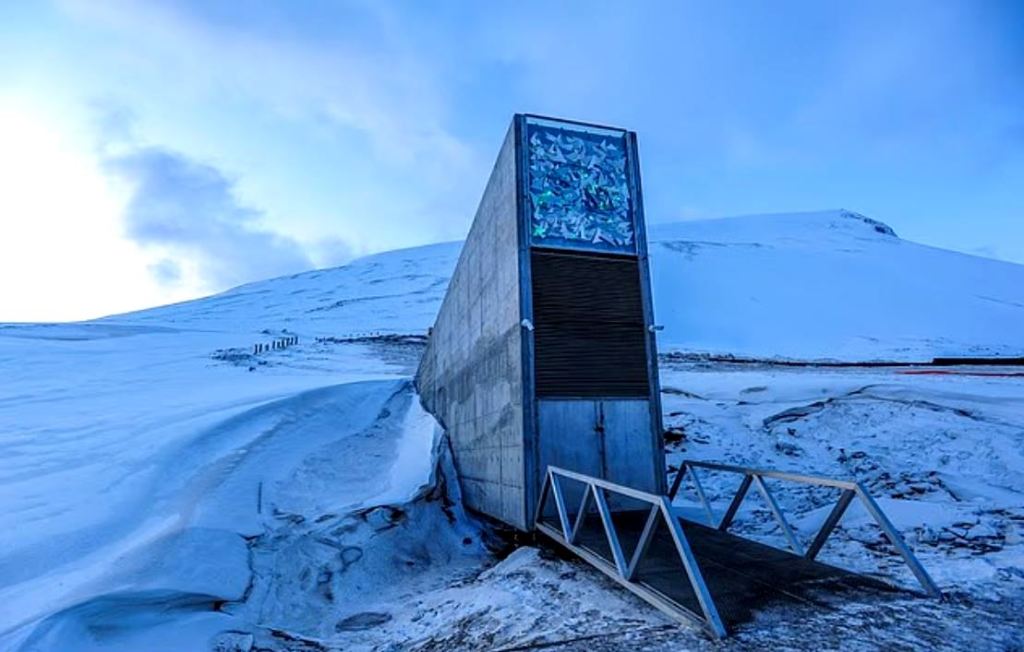
A bunker hidden in the Arctic might sound like somewhere a Bond villain would hide out – but the real–life ‘Doomsday Vault’ actually serves a very serious purpose.
The Svalbard Global Seed Vault, located beneath a mountain in Spitsbergen, a remote island in the Norwegian archipelago of Svalbard, houses ‘spare copies’ of seeds from around the world.
That collection has now been updated with over 7,800 seed varieties, including staple grains from Africa, olives from Spain, and ancient crops from Guatemala.
These new donations bring the total number of unique seeds safely stored beneath the ground to a staggering 1,386,102.
Dr Stefan Schmitz, Executive Director of the Crop Trust, says: ‘Backing up seeds in Svalbard is one of the easiest and most effective steps the world can take to protect the foundation of agriculture.’
The seeds are stored deep underground in freezers that keep them at a constant temperature of –18°C (–0.4°F).
The permafrost – the layer of soil that remains frozen all year round – and thick stone mean that the seeds will stay frozen, even if the power should fail.
That means the survivors of a war, climate catastrophe, or natural disaster will still have everything they need to restart global agriculture from scratch.
Millions of varieties of seeds are already stored in so–called ‘genebanks’ all over the world.
However, some genebanks are located in places that are less than ideal for long–term preservation.
‘Many of these are vulnerable, exposed not only to natural catastrophes and war, but also to avoidable disasters, such as lack of funding or poor management,’ Crop Trust explains on its website.
‘Something as mundane as a poorly functioning freezer can ruin an entire collection.’
The Svalbard Global Seed Vault’s goal is to act as a final ‘global backstop’ for these national organisations.
The so–called Doomsday Vault was opened in 2008 and is managed by the Norwegian Ministry of Agriculture and Food.
Unlike a normal seed vault, the Doomsday Vault operates with ‘black–box conditions’, under which the depositors remain the owners of the seeds and are the only ones who can withdraw them for any reason.
Rather than supporting research, the aim is to ensure that seed vaults can replenish their collections should disaster strike.
For this reason, the Doomsday Vault is set up for long–term storage.
Seeds are sealed in custom–made three–ply foil packages, which are sealed inside boxes and stored on shelves inside the Seed Vault.
The very low temperature and moisture levels inside the vault mean that the seeds use their energy reserves very slowly, keeping them viable for long periods of time.
The vault itself is also located in an ideal position to keep seeds safe and secure far into the distant future.
‘Svalbard is the farthest north a person can fly on a scheduled flight, offering a remote location that is nevertheless accessible,’ Crop Trust explained.
Likewise, although the entrance is visible from the surface, the actual vault is more than 100 metres below the surface.
This ensures that the seeds will remain frozen and viable even if the power fails in the future.
The area is geologically stable, and the humidity levels are low, while the Seed Vault is also well above sea level.
Crop Trust adds: ‘[It is] protected from ocean flooding according to worst–case scenario sea–level rises.’
The Arctic vault has the capacity to store up to 500 seeds from 4.5 million varieties of crops – a total of 2.5 billion seeds.
That collection has now grown by almost 8,000 seeds as collections from 10 depositors arrived for long–term safeguarding.
That includes seeds from two countries, Guatemala and Niger, that have never had seeds included in the vault before.
Guatemala’s donation includes two varieties of teosinte, a wild ancestor of maize native to the country and still grown by indigenous farmers.
Niger, meanwhile, stored 204 varieties of staple crops, including sorghum, cowpea, groundnut and pearl millet.
In another first, a donation from the Olive Genebank of the University of Córdoba included wild olive seeds from Spain and seeds of the 50 most important cultivated olive varieties worldwide.
Dr Concepción Muñoz Díez, of the University of Córdoba, says: ‘Local olive varieties are endangered by ageing of trees, low profitability of traditional olive groves and the spread of improved varieties that are easier to mechanise.’


 END TIMES PROPHECY WATCH
Leave a comment