

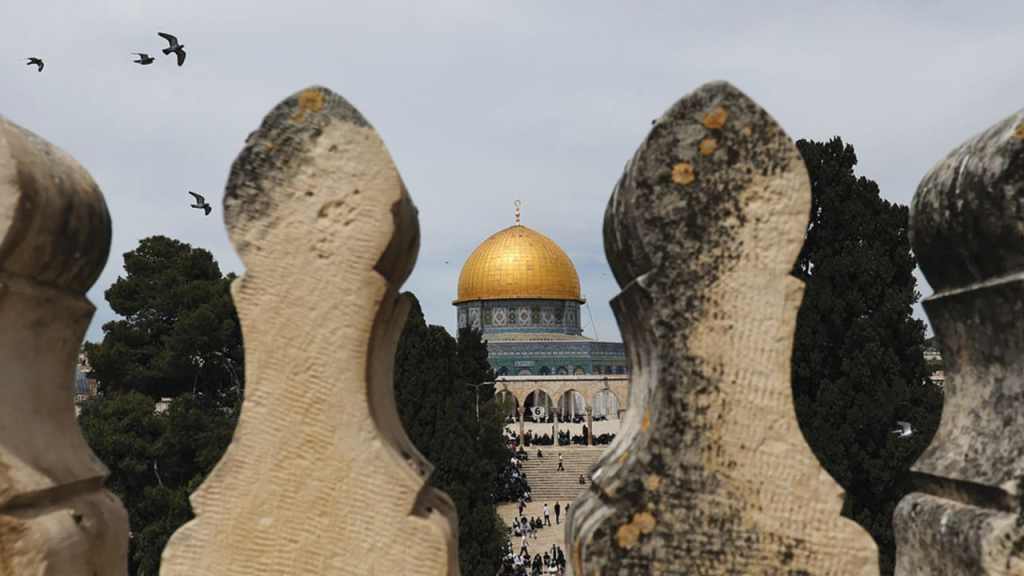
Escorted by police, a group of about 25 people walked across the Temple Mount esplanade to the steps leading up to the Dome of the Rock, the site where the First and Second Temples once stood.
They climbed a few steps toward the mosque, singing “Yedid Nefesh” (“soulmate”), usually sung on Friday nights.
“Are you with us?” a policeman asked this reporter.
When I said no, he told me to stop filming as participants in the group continued to video themselves walking on the large courtyard of the mount.
The men did not want to be interviewed, but Ilana, one of the few women in the group – who asked that only her first name be used – agreed to speak.
Wearing a white kerchief covering her hair, Ilana said she had immigrated to Israel from the Ukraine.
“I used to go to pray at the Kotel,” she said, referring to the Western Wall, just below the Temple Mount. “But then I started coming here whenever I had the opportunity. It feels very special to pray here.”
A few Muslims sitting on a nearby stone wall watched the group silently.
Ali, who said he goes to pray every day at Al-Aqsa (so called because it was “the farthest” mosque from Mecca when the Quran was revealed), said Jewish groups visiting and even praying there doesn’t bother him.
“It does disturb some people, but it doesn’t bother me,” he said. “If they do it quietly, it’s okay. People should worship God in the way they want to.”
But other Palestinians disagreed. A group of three women from the Galilee, who said they come about once a week to pray at the mosque for their families and for those who were killed in Gaza, frowned as they watched the Jewish group.
“This place is for Islam, and Jews are supposed to pray at the Wall,” Samira said.
Indeed, that has been the case since 1967 when Israel took over Jerusalem’s Old City from Jordan during the Six Day War. For many Israelis, it was the fulfillment of a dream, with the chance to pray at the Kotel – the Western Wall. The iconic photo of three paratroopers standing at the Wall is inscribed into every Israeli’s DNA.
The Temple Mount, which Muslims call the Haram al-Sharif, is holy to both Jews and Muslims.
For Jews, it is the site of both the First and Second Temples (destroyed in 586 BCE and 70 CE, respectively), and the holiest site in Judaism. For Muslims, it is the site where Mohammed ascended to heaven on a miraculous trip called Isra’ and Mi’raj (“the night journey and ascension”) and is the third-holiest site after Mecca and Medina.
Some approve, others don’t
When Israel conquered east Jerusalem in 1967 and later annexed it, then-defense minister Moshe Dayan made a controversial decision to allow the Waqf (Islamic religious trust) to continue administering the site, while Israel would be responsible for its security.
In an effort to ease potential tensions in 1967, the government made a decision that while Jews could visit the site, they could not pray, dance, or engage in any other religious activity.
As part of the deal, while Muslim prayer is permitted in the area, and hundreds of thousands go there to pray during the Muslim holy month of Ramadan (see box), Jewish prayer was not permitted.
The area has long been a flashpoint for Israeli-Palestinian tensions, and riots have repeatedly broken out after Muslim worshipers threw rocks at Jews praying at the Western Wall below and police stormed the area.
Hamas’s name for the massacre of Oct. 7, 2023, is “Al-Aqsa Flood,” an effort to rally the Muslim world around this religiously significant location.
In the past few years, the number of Jews ascending to the Temple Mount has increased dramatically to more than 68,000 in the Hebrew year that ended in September 2025, an increase of 22% over the previous year, according to the Beyadenu activist group. The change is also partly due to recent rabbinic rulings that according to Jewish law, Jews are allowed to visit part of the Temple Mount esplanade – the large area that includes both the Dome of the Rock and the Aqsa Mosque.
Some rabbis have said that Jews should not visit the area, either because of ritual purity laws or because there are some parts like the Holy of Holies that only the high priest was allowed to enter, and only on Yom Kippur.
Now, in the past few weeks, in what amounts to a dramatic change to the status quo that has prevailed since 1967, police have begun to allow Jewish prayer on the Temple Mount under certain conditions.
Not a concentration camp
Five months ago, Rabbi Leo Dee, whose first wife and two of their daughters were killed in a terrorist attack on April 7, 2023, ascended the Temple Mount on the day of his second wedding.
He said it is a custom to go to the site on your wedding day. He arrived at the Mugrabi Gate, the entrance that is designated for non-Muslims to use, wearing his tefillin.
“Usually, as you go through security, the police ask you to remove your tefillin, but somehow this time they didn’t notice,” he told the Magazine.
“We davened [prayed] all of “Shaharit” from our phones,” he said, “then we danced for a few minutes celebrating my wedding. One of the policemen said, ‘I’d like to escort you to the chief of police because it’s forbidden to put on tefillin.’ I responded that the only place I thought it was forbidden was in concentration camps in Germany.”
Dee said that prayer at the site feels different.
“When you pray there, you pray as near as you can to where Jacob had his dream about the ladder, to where Abraham and his son Isaac were for the Akeida [the binding of Isaac], to where our ancestors would sacrifice animals, and to the place where the Shechina [the presence of God] dwells.”
In any case, in the past few weeks police have allowed Jews to enter the Temple Mount compound with prayer pages, printed by the Temple Mount Yeshiva, whose leaders are close to National Security Minister Itamar Ben-Gvir. This change comes just weeks after he appointed his close associate, Maj.-Gen. Avshalom Peled, as commander of the Jerusalem District Police.
Real status quo change?
Israeli officials deny that there has been a major change to the status quo.
“The Israel Police operates throughout the year to enable freedom of worship and visitation to the Temple Mount for all religions and communities, while strictly maintaining public order and the rules in place at the site, in accordance with the directives of the political echelon,” the police spokesman said in a statement in response to a request for an interview by the Magazine.
“Following a request submitted by the administration of the Temple Mount Yeshiva, the police approved the entry of guidance sheets for visitors,” the statement said. “However, in order to maintain the existing order, it was determined that the use of these sheets would be limited to specific areas defined by the police.
“The Israel Police continues to act with discretion and responsibility in order to maintain a balance between the various needs at the Temple Mount,” it concluded.
But for those who have long advocated for Jewish prayer there, the new rules are a step in the right direction.
“Four years ago, someone would utter a prayer under his breath or say a quick ‘Kaddish,’” said Yisrael Medad, who has been up to the Temple Mount hundreds of times, beginning in 1970. “Now people can prostrate themselves and the police let them pray, sometimes for up to five minutes.”
He has even led tours of the Temple Mount.
“For many people, it is a very powerful experience,” he said. “And if they [Muslims] can pray there, we should be able to pray there.”
Rabbi Dee goes even further.
“We should declare sovereignty over the Temple Mount,” he said. “As long as it is in their hands, they believe they are the sovereign rulers.”


 END TIMES PROPHECY WATCH
Leave a comment