

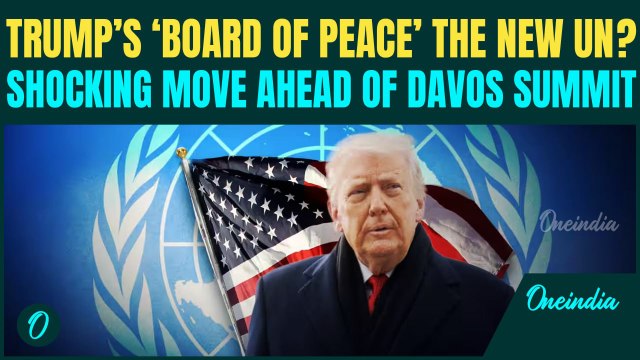
The most dangerous thing about Donald Trump’s proposed Board of Peace is not what it plans to do in Gaza, but it signals about its aspirations for the global order.
At a moment when the United Nations is warning of an imminent financial crisis driven largely by unpaid US dues, Trump is advancing a parallel forum that bypasses the UN’s rules, universality and legal foundations. This timing is not a coincidence. It reflects a Washington worldview in which institutions are not repaired but sidestepped, pressured or fed into the woodchipper. In this approach, recognised and legitimate representation is replaced by a narrowing circle of oligarchs and authoritarians.
Washington has since announced an initial payment toward its UN arrears, presenting it as evidence of renewed commitment. Considering recent developments, it is better understood as short-term relief rather than a strategic recommitment. A partial payment may buy time, but it does not resolve the structural uncertainty hanging over the UN’s finances, nor does it change the trajectory of creating parallel fora designed to operate outside the UN’s legal and institutional framework. Funding delivered in fragments and conditioned on reform creates uncertainty rather than stability. Such uncertainty weakens planning, erodes authority and creates space for alternatives that claim to be more effective precisely because the system they bypass has been starved into irrelevance.
Moreover, new international fora are not cost-neutral. The billions reportedly demanded for participation in the Board of Peace would be drawn from the same national budgets that sustain the UN. Every euro or dollar redirected into access-based forums is one less available for renewing the UN’s core functions, peace operations and humanitarian coordination.
Europe should be clear-eyed about the risks. The immediate question is not whether the Board of Peace can deliver stability in Gaza. The deeper danger lies in normalising a model in which global crises are managed outside the UN while the UN itself is left in a state of permanent financial fragility, perpetually months away from collapse. Once that threshold is crossed, the damage is hard to reverse. A weakened UN does not fail dramatically; it simply becomes a lesser option. Power then migrates to smaller rooms with fewer rules, where outcomes are shaped by brute force rather than laws and norms.
The European project is built on the belief that law tempers power and that institutions should outlast personalities. A world in which peace processes are convened ad hoc by whomever controls the purse strings is a world in which Europe’s comparative advantage erodes fast. The Board of Peace is not a credible replacement for the UN, but it doesn’t need to be. It only needs to reinforce a perception that the UN no longer works reliably.
Brussels’ response should therefore be urgent and decisive. Europe, together with the United Kingdom, Canada, Japan and other democracies, should move to stabilise UN finances in a predictable manner. Bridging the UN’s liquidity gap buys time for change without conceding the field to informal substitutes. Reform driven by crisis is still reform; reform attempted after collapse is a much steeper mountain to climb.
Beyond emergency stabilisation, the EU should work with like-minded partners to anchor a reform agenda that strengthens the UN rather than replaces it. This requires coordination with middle powers and major democracies to modernise decision-making, improve financial predictability and reinforce operational credibility. Reform must become a shared investment in legitimacy, not a pretext for supplanting the UN.
At the same time, Europe should not refuse diplomacy simply because it dislikes the forum of the Board of Peace. If talks on Gaza take place, European actors should engage where outcomes align with international law, humanitarian principles and existing mandates. What Europe must not do is lend legitimacy to this new alternative operating outside of international law that treats universality as an inconvenience. Engagement does not require endorsement, provided the distinction is held firmly.
If the UN is to remain the backbone of global order, Europe, India, Japan and other leading democracies must build more muscle around it. That means strengthening the Security Council, investing in operational capacity, enforcing sanctions and ensuring that reconstruction mechanisms continue to function when global institutions are under stress.
If the UN’s financial crisis deepens despite partial payments, continuity will matter more than rhetoric. Humanitarian operations, monitoring missions and coordination platforms must not be allowed to fail when funding runs thin. Planning to sustain essential functions during austere periods is only prudent.
The Board of Peace may never fully materialise, given legal challenges, political backlash and its own internal contradictions. But the signal it sends is already clear. Europe should respond with resolve to keep the UN operating system running, even while others experiment with shortcuts that will not be there when the final bill comes due.


 END TIMES PROPHECY WATCH
Leave a comment