

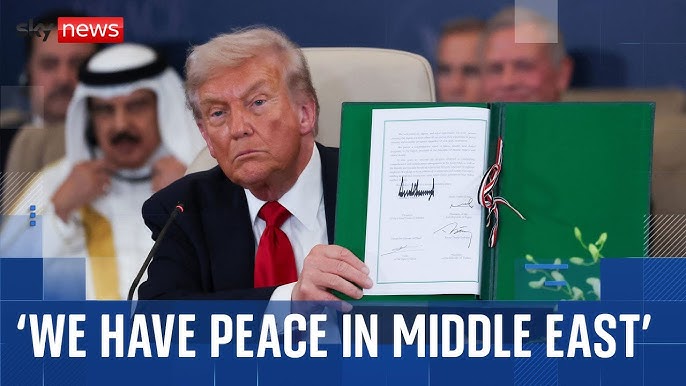
Trump, joined by Muslim leaders, declares: ‘We have peace in the Middle East’; many Western allies stay away amid concerns that body set up to deal with Gaza could usurp role of UN
US President Donald Trump on Thursday inaugurated his Board of Peace to lead efforts at maintaining a ceasefire in Israel’s war with the Hamas terror group, insisting that “everyone wants to be a part” of a body that could eventually rival the United Nations — despite many US allies opting not to participate.
In a speech at the World Economic Forum in Davos, Switzerland, Trump sought to create momentum for a project to map out a future of the war-torn Gaza Strip that has been overshadowed this week, first by his threats to seize Greenland, then by a dramatic retreat from that push.
“This isn’t the United States, this is for the world,” he said of the Board of Peace, adding, “I think we can spread it out to other things as we succeed in Gaza.”
The event featured a video message from Ali Shaath, the chief commissioner of the newly established National Committee for the Administration of Gaza (NCAG), a 12-member panel of Palestinian technocrats tasked with replacing Hamas in running Gaza’s daily affairs.
“This transition will succeed only if it delivers real tangible improvements in daily life for Gazans,” Shaath said before announcing that the Rafah Crossing will reopen next week in both directions — something Israel has refused to allow before the body of the last deceased hostage, Ran Gvili, is returned and Hamas has given up its weapons.
But Board of Peace High Representative Nickolay Mladenov announced later Thursday that “an agreement has been reached” on the matter, indicating that Jerusalem had been consulted and was privately on board.
PEACE IN THE MIDDLE EAST: Ali Shaath, Chief Commissioner of the National Committee for the Administration of Gaza, thanks President Trump for his leadership, announces the reopening of the Rafah crossing, and outlines a path toward a more prosperous future for Gaza. pic.twitter.com/1RMol3E4tE
— The White House (@WhiteHouse) January 22, 2026
Prime Minister Benjamin Netanyahu’s office didn’t deny the plan to reopen Rafah, issuing a statement to reporters attributed to an anonymous Israeli official who said, “A special effort is underway to return the body of the late Ran Gvili, while making full use of the information in our possession. The security cabinet will discuss this issue and the matter of opening the Rafah crossing at the beginning of next week.”
The new peace board was initially envisioned as a small group of world leaders overseeing the ceasefire, but it has morphed into something far more ambitious — and skepticism about its membership and mandate has led some countries usually closest to Washington to take a pass.
Trump appeared to reinforce some of those fears, declaring, “Once this board is completely formed, we can do pretty much whatever we want to do.”
Trump tried not to let those not participating ruin his unveiling party, saying 59 countries had signed onto the board — even though heads of state, top diplomats and other officials from only 19 countries plus the US actually attended. He told the group, ranging from Azerbaijan to Paraguay to Hungary, “You’re the most powerful people in the world.”
Trump has spoken about the board replacing some UN functions and perhaps even making that entire body obsolete one day. But he was more conciliatory in his remarks on the sidelines of the forum in the Swiss alps.
“We’ll do it in conjunction with the United Nations,” Trump said, even as he denigrated the UN for doing what he said wasn’t enough to calm some conflicts around the globe.
US Secretary of State Marco Rubio said that some countries’ leaders have indicated they plan to join but still require approval from their parliaments, and the Trump administration says it has also gotten queries about membership from countries that hadn’t been invited to participate yet.
Netanyahu has agreed to join the peace board, after his office has earlier criticized the makeup of the board’s committee tasked with overseeing Gaza, but the premier did not allow for an Israeli representative to take part in the Thursday signing ceremony, even though President Isaac Herzog and Economy Minister Nir Barkat were already in Davos.
Big questions remain, however, about what the eventual board will look like, as key US allies including France and Britain have expressed skepticism, with the UK saying it would not attend the ceremony and a senior official in Paris saying this week that the board’s charter “goes beyond the framework of Gaza alone” and “raises major questions, particularly regarding respect for the principles and structure of the United Nations, which must under no circumstances be called into question.”
Also complicating European participation was the invitation extended to Russian President Vladimir Putin, who has said that his country is still consulting with Moscow’s “strategic partners” before deciding whether to commit.
Others are asking why Putin and other authoritarian leaders had even been invited to join. Britain’s foreign secretary, Yvette Cooper, said her country wasn’t signing on “because this is about a legal treaty that raises much broader issues.”
“And we do also have concerns about President Putin being part of something which is talking about peace, when we have still not seen any signs from Putin that there will be a commitment to peace in Ukraine,” she told the BBC.
Norway and Sweden have also indicated that they won’t participate.
Perhaps giving countries additional pause, the Board of Peace’s charter, which was obtained and published first by The Times of Israel this week, places Trump as both the board’s chairman for life and as the representative for the US. While the charter says each country will be represented by its head of state or government, it says that Trump will also serve as inaugural head of the body, a role that can only be replaced “following voluntary resignation or as a result of incapacity, as determined by a unanimous vote of the Executive Board.”


 END TIMES PROPHECY WATCH
Leave a comment