

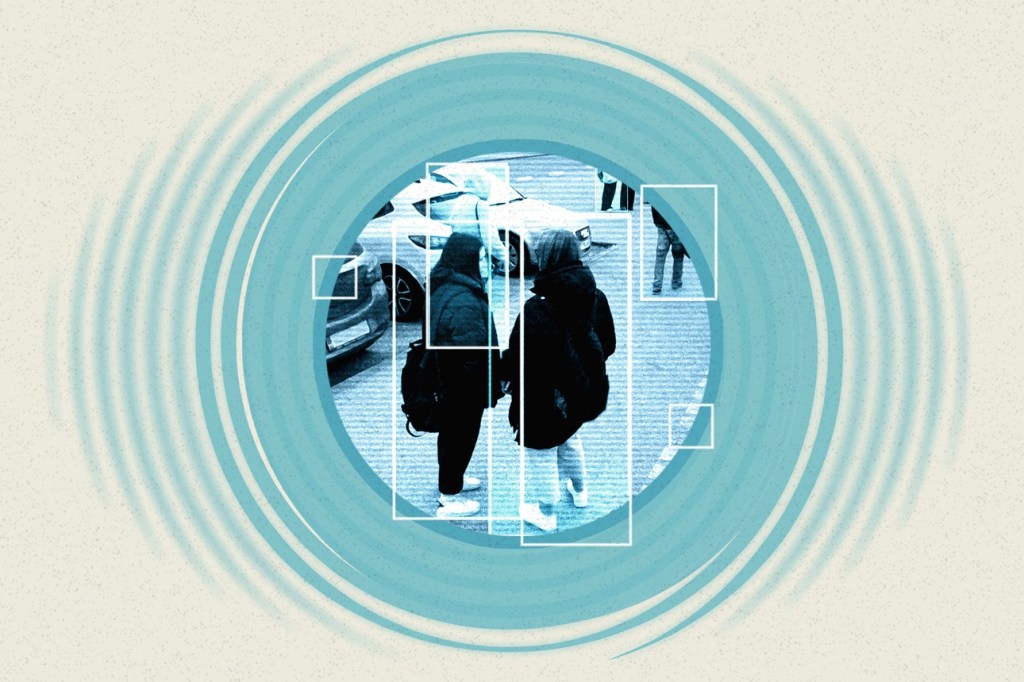
The U.S. Immigration and Customs Enforcement is buying millions of dollars’ worth of new surveillance tools at the same time President Donald Trump has scaled back protections for use of civilian data — a combination that could lead to a vast expansion of domestic surveillance that goes far beyond immigrants.
Federal records show that ICE has increased its spending on surveillance technology, looking to spend more than $300 million under Trump for social-media monitoring tools, facial recognition software, license plate readers and services to find where people live and work.
These upgrades are expected to be used in ICE’s push to help fulfill the president’s campaign promise of “the largest deportation program of criminals in the history of America.”
The high-tech capabilities are also coinciding with policy changes from the White House that lower the guardrails around the government’s use of data on millions of American residents and expand its potential surveillance targets. A set of executive orders is giving ICE workarounds for the decades-old federal standard that protects American residents’ privacy, and the agency itself is signaling a shift in its enforcement policy, looking beyond immigrants and toward American critics of its officers’ behavior.
ICE’s new capabilities and legal flexibility are raising concerns among privacy and civil liberty advocates that it is expanding its remit with little supervision of its powers.
“It’s very troubling, especially when you pair the ramp-up of these capabilities and the increasing exercises of these capabilities with the undermining of independent oversight,” said Sharon Bradford Franklin, who chaired a board tasked with independently scrutinizing government surveillance following the Sept. 11, 2001 terrorist attacks.
A White House spokesperson referred POLITICO to ICE for questions about the agency’s operations. ICE did not respond to questions about its protections against potentially excessive surveillance.
Governors in several blue states have already responded by restricting ICE’s access to state-level citizen data. New York, Illinois, Massachusetts, Minnesota and Washington recently cut off ICE’s access to their state motor vehicle records. In Congress, a coalition of 40 Democrats asked other governors to follow, saying in a letter that ICE’s access to DMV records allowed for “unjustified, politicized actions” from the Trump administration.
ICE’s use of facial recognition to determine immigration status has particularly troubled Democrats who worry the technology puts Americans at risk of detention and deportation.
The House Homeland Security Committee’s ranking member, Bennie Thompson (D-Miss.), criticized it as a “frightening, repugnant, and unconstitutional attack on Americans’ rights and freedoms” in a statement to POLITICO.
Republicans have been more accepting of ICE’s expanded surveillance capabilities, though still within limits.
Sen. Josh Hawley (R-Mo.), who has criticized the Biden administration’s surveillance against conservatives, told POLITICO that he supports ICE’s acquisition of surveillance tech “so long as it’s done constitutionally.”
“Acquiring the stuff, that’s no problem,” he said, citing the importance of Fourth Amendment protections against unreasonable searches by the government. “How they use it really matters.”
Buying tech, and broadening the mission
ICE’s technology arsenal has sharply increased in the past year, with the agency investing in high-tech surveillance tools including social media monitoring powered by artificial intelligence, software to obtain phone location data, drones, license plate readers and iris scanners.
One of its largest investments is for “skip-tracing” services, typically used by debt collectors and bounty hunters to track people who are difficult to find, across new identities, homes and occupations.
These capabilities were not used by ICE in past administrations. They were recommended to the Trump White House as part of a sweeping crackdown strategy submitted by private military contractors last December.
In October, ICE awarded two contracts for skip-tracing capabilities totaling $8 million. It vastly expanded its ambitions in November, issuing a request for information for the data-intensive tracking service with a potential $281 million contract attached. In December, ICE awarded contracts to 10 companies for skip tracing services, with the potential to earn over $1 billion by the end of their contracts in 2027, The Intercept reported.
A spokesperson for ICE said the November request wasn’t a formal spending plan, but was intended as “market research” to see how many vendors could fulfill an order of this size.
In September ICE paid $3.8 million for facial recognition tools from the company Clearview AI, which operates a database of 30 billion images scraped from online sources.


 END TIMES PROPHECY WATCH
Leave a comment