

US president’s son-in-law, key figure in 2020 Abraham Accords but absent at start of Trump’s 2nd term, now teaming up with Steve Witkoff to tackle difficult conflicts
As the dawn rose on US President Donald Trump’s second term, one key figure from his first administration stood back, content to focus on his personal business interests and not retake a formal government role.
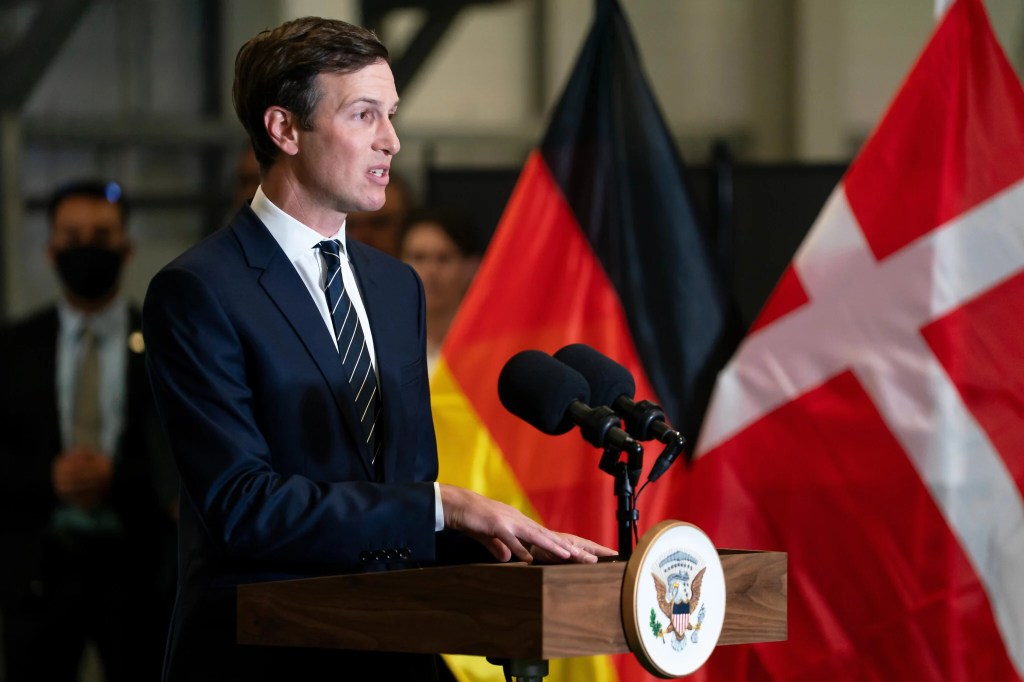
Now, nearly a year into Trump 2.0, Trump’s son-in-law Jared Kushner has been drawn back into the foreign policy fold and is taking a greater role in delicate peace negotiations. Talks had initially been led almost solo by special envoy Steve Witkoff, a real estate mogul who had no government experience before this year.
The shift reflects a sense among Trump’s inner circle that Kushner, who has diplomatic experience, complements Witkoff’s negotiating style and can bridge seemingly intractable differences to close a deal, according to several current and former administration officials who, like others, spoke on condition of anonymity to discuss the internal deliberations.
Kushner, who like Witkoff is Jewish, played a key part in brokering the Abraham Accords, which normalized relations between Israel and several Arab countries at the end of Trump’s first term. He was also at the center of other foreign policy initiatives.
In recent months, Kushner joined Witkoff in the later stages of negotiations for a ceasefire and hostage-release deal between Israel and Hamas in Gaza, which was inked in October. And Kushner’s second-term role was also on display this weekend as he and Witkoff took part in a blitz of diplomacy in Miami.
On Sunday, they concluded two days of talks with Russian negotiator Kirill Dmitriev in Miami on the latest proposals to end Russia’s war in Ukraine.
The talks with Dmitriev came after they met on Friday in Florida with the Ukrainian negotiating team, led by Rustem Umerov, as well as senior British, French and German national security officials. The Ukrainians and European officials stuck around Florida for more talks with US government officials facilitated by Trump’s envoys.
Witkoff and Kushner also squeezed in meetings on Friday with Turkish and Qatari officials to discuss the Gaza truce, as they look to implement the second phase of Trump’s ceasefire plan, which aims to establish longer-term security and governance structures for the territory.
Witkoff, a longtime pal of Trump’s, is seen by some inside the administration as an oversize character who has traveled the world for diplomatic negotiations on his private jet and does not miss an opportunity to publicly praise the president for his foreign policy acumen, the officials say.
Kushner has his own complicated business interests in the Middle East and a sometimes transactional outlook to diplomacy that has distressed some officials in European capitals, a Western diplomat said.
Still, Kushner is seen as a more credible negotiator than Witkoff, who is viewed by many Ukrainian and European officials as overly deferential to Russian interests, the diplomat said. The war began with Moscow’s invasion of Ukraine in February 2022.
“Kushner has a bit more of a track record from the first administration,” said Ian Kelly, a retired career diplomat and former US ambassador to Georgia who now teaches diplomacy at Northwestern University. Kelly stressed, however, that the jury is still out on Kushner’s intervention.
Trump views Kushner as a “trusted family member and talented adviser” who has played a pivotal role in some of his biggest foreign policy successes, said White House deputy press secretary Anna Kelly.
Trump and Witkoff “often seek Mr. Kushner’s input given his experience with complex negotiations, and Mr. Kushner has been generous in lending his valuable expertise when asked,” Kelly added.
US State Department spokesman Tommy Pigott called Kushner “a world-class negotiator.” Pigott noted that Secretary of State Marco Rubio is grateful for Kushner’s “willingness to serve our country and help President Trump solve some of the world’s most complex challenges.”
In an interview with CBS’s “60 Minutes” in October, Kushner spoke about his unconventional approach to diplomacy.
“I was trained in foreign policy really in President Trump’s first term by seeing an outsider president come into Washington with a different school of foreign policy than had been brought in place for the 20 or 30 years prior,” he said.
But some Democrats and government oversight groups have expressed skepticism about Kushner’s role in shaping the administration’s policies in the Middle East while he manages billions of dollars in investments, including from Saudi Arabia and Qatar’s sovereign wealth funds, through his firm, Affinity Partners.
Similarly, Witkoff has faced scrutiny for his and his family’s deep business ties to Gulf nations. Witkoff last year partnered with members of Trump’s family to launch a cryptocurrency company, World Liberty Financial, which received a $2 billion investment from a United Arab Emirates-controlled wealth fund.
“What people call conflicts of interests, Steve and I call experience and trusted relationships that we have throughout the world,” said Kushner, who is not drawing a salary from the White House for his advisory role, which is not formalized.
White House counsel David Warrington said in a statement that Kushner’s efforts for Trump “are undertaken in full compliance with the law.”
“Given that Jared Kushner was a critical part of the efforts leading to the historic Abraham Accords and other diplomatic successes in the first Trump Administration, the President asked Mr. Kushner to be available as the President engages in similar efforts to bring peace to the world,” Warrington said in a statement. “Mr. Kushner has agreed to do so in his capacity as a private citizen.”


 END TIMES PROPHECY WATCH
Leave a comment