

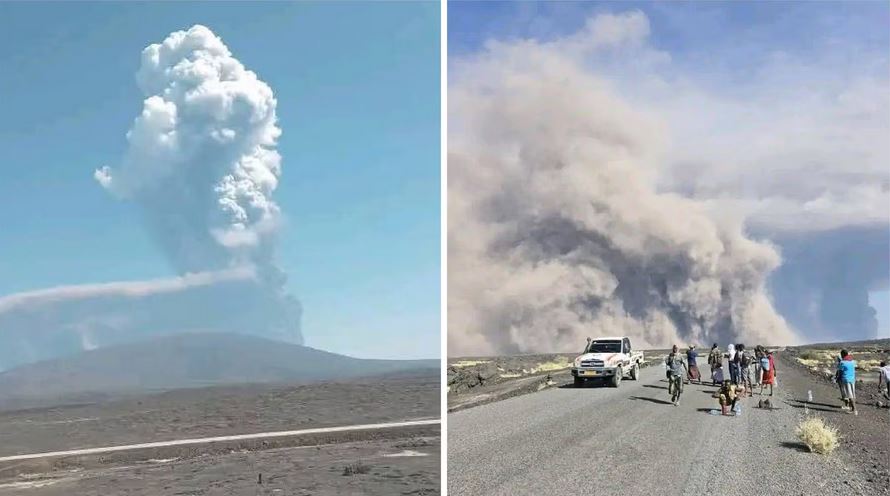
A volcano in Ethiopia’s northeastern region erupted for the first time in nearly 12,000 years, sending thick plumes of smoke up to nine miles into the sky, the Toulouse Volcanic Ash Advisory Centre (VAAC) said.
The Hayli Gubbi volcano, located in Ethiopia’s Afar region about 500 miles northeast of Addis Ababa near the Eritrean border, erupted on Sunday for several hours.
The volcano, which rises about 1,500 feet yards in altitude, sits within the Rift Valley, a zone of intense geological activity where two tectonic plates meet.
Ash clouds from the volcano drifted over Yemen, Oman, India, and northern Pakistan, said the VAAC, which posted a map of the path of the ash cloud.
Air India said on Tuesday said it had canceled at least 11 flights due to the ash plumes, and Akasa Air said it canceled flights to some Middle East destinations, the Reuters news agency reported.
Simon Carn, a volcanologist and professor at the Michigan Technological University, confirmed on Bluesky that the ash cloud was “spreading rapidly east in the subtropical jet stream, over the Arabian Sea towards NW India and Pakistan.”


 END TIMES PROPHECY WATCH
Leave a comment