

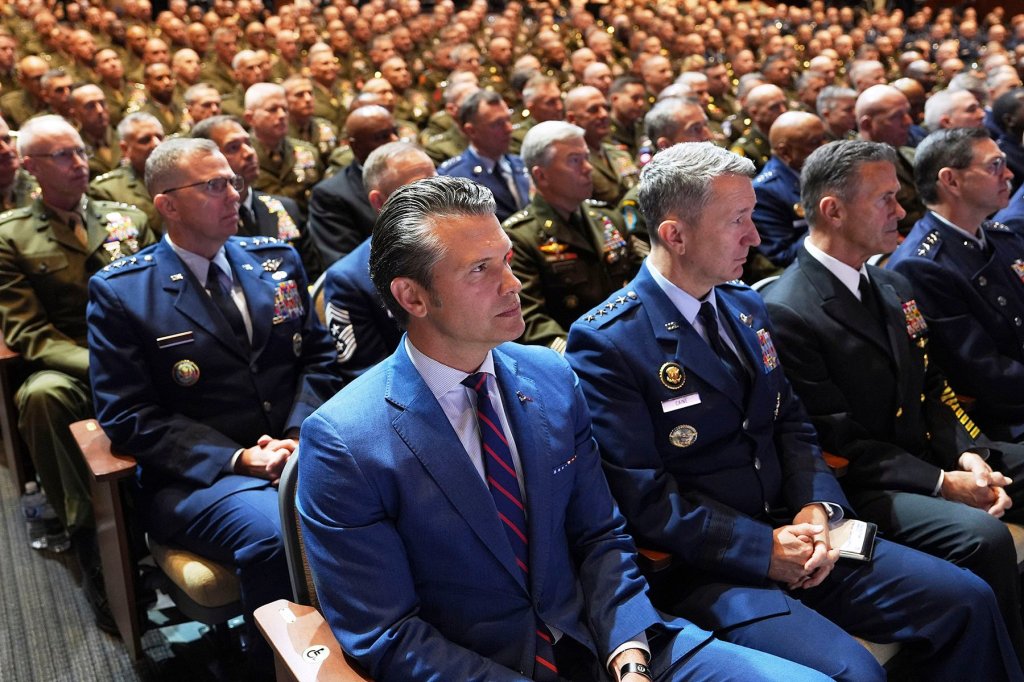
In a dramatic address to the nation’s top military brass, Defense Secretary Pete Hegseth has delivered a no-holds-barred call to arms, urging the Pentagon’s senior leadership to refocus on its core mission amid a rapidly evolving global landscape.
Speaking at a rare gathering of the U.S. military’s highest-ranking officials, Hegseth—former Fox News host and staunch Donald Trump ally—rechristened the Department of Defense as the “Department of War” and laid out a vision centered on unrelenting preparedness.
The speech, delivered under the Trump administration’s renewed emphasis on strength through deterrence, comes at a time when geopolitical tensions are simmering across multiple fronts, from the Indo-Pacific to Eastern Europe.
Hegseth’s words mark a sharp pivot from what he and his supporters view as years of bureaucratic drift and “woke” distractions in the military. Instead, he positioned the institution as a warfighting machine, ready to defend American interests without apology.
“From this moment forward, the only mission of the newly restored Department of War is this: Warfighting,” Hegseth declared, his tone resolute as he addressed the assembled generals and admirals.
This bold renaming echoes historical precedents, harking back to the department’s origins as the War Department before its 1947 rebranding, and signals the administration’s intent to strip away perceived layers of political correctness that, in Hegseth’s view, have softened the military’s edge.
But Hegseth was quick to temper the rhetoric with a nod to the ultimate goal of his directive. “Preparing for war and preparing to win. Unrelenting and uncompromising in that pursuit,” he continued. “Not because we want war. No one here wants war. But it’s because we love peace.”
“It’s completely unacceptable to see fat generals and admirals in the halls of the Pentagon leading commands around the country, in the world, it’s a bad look,” Hegseth said.
The address has already sparked intense debate. Supporters hail it as a return to the unvarnished realism that won the Cold War, praising Hegseth’s outsider perspective as a breath of fresh air for an institution bogged down by endless deployments and diversity initiatives.
Critics, however, warn that the provocative language risks alienating allies and escalating tensions unnecessarily, potentially undermining diplomatic efforts at a fragile moment in international relations.
Hegseth, who rose to prominence through his bestselling book The War on Warriors—a scathing critique of military “wokeness”—has long advocated for a back-to-basics approach.
In his confirmation hearings, he lambasted what he called “generals who prioritize pronouns over projectiles,” arguing that ideological experiments have eroded combat readiness.
This speech appears to be the first major public test of his influence over the Joint Chiefs and combatant commanders, many of whom have served under previous administrations with more measured tones.
As the Trump administration settles into its second term, Hegseth’s message underscores a broader strategy: deterrence through dominance.
By framing the military’s role explicitly around warfighting, the administration aims to project unyielding resolve to adversaries, from Beijing to Moscow. Yet, the “love peace” caveat suggests a nuanced undercurrent—preparation not as provocation, but as the surest path to stability.
Hegseth also railed against what he described as “woke” in his department. “No more identity months, DEI offices, dudes in dresses, no more climate change worship, no more division, distraction or gender delusion, no more debris. I’ve said before and will say again, we are done with that s***,” the Secretary of Defense said.


 END TIMES PROPHECY WATCH
Leave a comment