

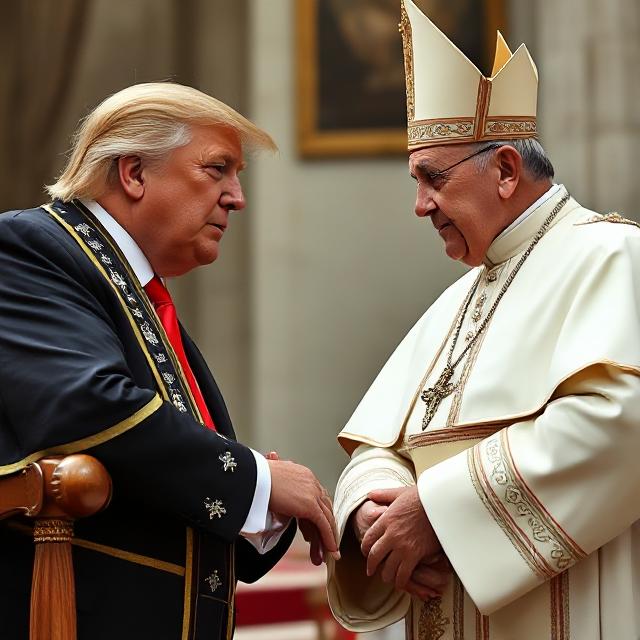
Just as Ronald Reagan and Pope John Paul II worked to defeat the USSR, Donald Trump and Pope Leo XIV can confront Putin’s Russia.
President Trump’s Truth Social message after his phone conversation with President Putin revealed that the Vatican would be “very interested in hosting the negotiations” in the Russia-Ukraine War. The election of Pope Leo has introduced a significant new player on the geopolitical stage—one seemingly willing to wield the Vatican’s moral authority and diplomatic resources to promote peace in Ukraine. For the Trump administration and European nations, Pope Leo may prove to be an invaluable partner.
In recent history, the most influential pope in global politics was John Paul II. Alongside President Ronald Reagan and British prime minister Margaret Thatcher, John Paul formed a formidable trio in the 1980s. This alliance is widely credited with helping dismantle the Soviet Union’s grip on Eastern Europe and hastening the end of the Cold War.
Reagan and John Paul shared not only values—like staunch anti-communism—but also personal experiences. Both survived assassination attempts in 1981 just months apart. Today, similar parallels are emerging: President Trump’s strong Christian support base, his admiration for Reagan’s legacy, and Pope Leo’s American roots may bring these leaders closer, forging a new geopolitical partnership.
Trump’s political philosophy bears many similarities to Reagan’s from the 1980 “Let’s Make America Great Again” campaign slogan, echoing Reagan’s optimism, to economic policies that favor tax cuts and smaller government, as well as bolstering national defense, reminiscent of Reagan’s Strategic Defense Initiative and Trump’s own “Golden Dome” plans.
Inspired by Reagan’s close collaboration with John Paul, Trump might similarly seek to build a powerful alliance with Pope Leo to influence global affairs, particularly to broker peace in Ukraine.
As a native of Poland, John Paul’s papacy was defined by his steadfast commitment to liberating Central and Eastern Europe from communist and Russian imperialism. As Poland endured martial law and the threat of Soviet military intervention, John Paul worked closely with the Reagan administration, which imposed economic sanctions against the Polish communist regime and the USSR. Among his priorities was ending Moscow’s repression of the Ukrainian Greek Catholic Church—a commitment he pursued throughout his papacy.
Pope Leo now faces a similarly fraught European crisis: the ongoing war in Ukraine, now in its fourth year. From the outset of his papacy last month, Pope Leo has demonstrated an acute concern for global affairs, particularly the war in Ukraine. In his very first Mass, he called for an end to the war in Ukraine, and his first meeting with a foreign leader was with President Volodymyr Zelensky.
This marks a subtle but notable departure from Pope Francis, who adopted a more cautious, neutral tone—condemning violence without directly criticizing Russian aggression. Additionally, Pope Leo has called for prayers for Catholics in China, a sensitive topic amid strained Vatican-Beijing relations.
Meanwhile, Russian President Putin and Patriarch Kirill of the Russian Orthodox Church are aggressively promoting their vision of traditional Christian values worldwide. Kirill, a key figure in Putin’s geopolitical strategy, was lauded by Cuba’s Fidel Castro in 2008 for opposing “American imperialism” and publicly supported Russia’s 2022 invasion of Ukraine.
Pope Leo brings a unique background that positions him to play a significant role in fostering peace in Ukraine. Born and raised in Chicago’s South Side—a diverse area home to Ukrainian, Lithuanian, Polish, and other immigrant communities—he has a deeper understanding of the cultures of Central and Eastern Europe. Additionally, his work with marginalized communities in Peru, along with his Peruvian citizenship, has broadened his global perspective and earned him greater sympathy from countries outside the sphere of major world powers.
In this fraught context, Pope Leo has the potential to emerge not only as a spiritual leader but as a pivotal figure in global politics. Like Pope John Paul before him, Pope Leo can leverage Vatican diplomacy and his moral authority to rally the democratic world against the authoritarian challenges posed by Russia, China, and other regimes. Building alliances with the Trump administration and European leaders—such as Germany’s new Chancellor Friedrich Merz of the Christian Democratic Union—could forge a stronger, more united coalition on the world stage.


 END TIMES PROPHECY WATCH
Leave a comment