

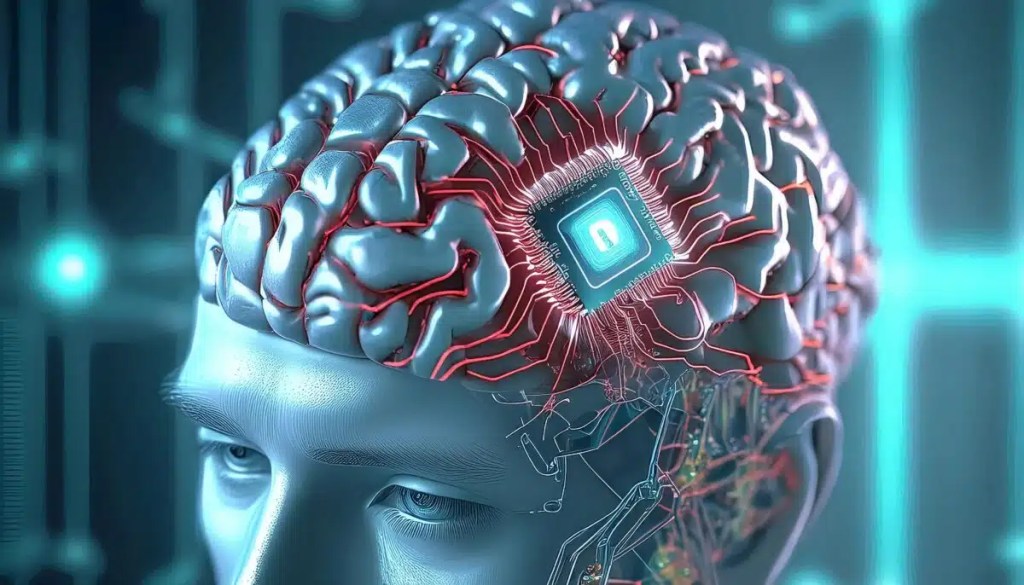
In the 1987 classic film RoboCop, the deceased Detroit cop Alex Murphy is reborn as a cyborg. He has a robotic body and a full brain-computer interface that allows him to control his movements with his mind. He can access online information such as suspects’ faces, uses artificial intelligence (AI) to help detect threats, and his human memories have been integrated with those from a machine.
It is remarkable to think that the movie’s key mechanical robotic technologies have almost now been accomplished by the likes of Boston Dynamics’ running, jumping Atlas and Kawasaki’s new four-legged Corleo. Similarly we are seeing robotic exoskeletons that enable paralyzed patients to do things like walking and climbing stairs by responding to their gestures.
Developers have lagged behind when it comes to building an interface in which the brain’s electrical pulses can communicate with an external device. This too is changing, however.
In the latest breakthrough, a research team based at the University of California has unveiled a brain implant that enabled a woman with paralysis to livestream her thoughts via AI into a synthetic voice with just a three-second delay.
The concept of an interface between neurons and machines goes back much further than RoboCop. In the 18th century, an Italian physician named Luigi Galvani discovered that when electricity is passed through certain nerves in a frog’s leg, it would twitch. This paved the way for the whole study of electrophysiology, which looks at how electrical signals affect organisms.
The initial modern research on brain-computer interfaces started in the late 1960s, with the American neuroscientist Eberhard Fetz hooking up monkeys’ brains to electrodes and showing that they could move a meter needle. Yet if this demonstrated some exciting potential, the human brain proved too complex for this field to advance quickly.
The brain is continually thinking, learning, memorizing, recognizing patterns and decoding sensory signals – not to mention coordinating and moving our bodies. It runs on about 86 billion neurons with trillions of connections which process, adapt and evolve continuously in what is called neuroplasticity. In other words, there’s a great deal to figure out.


 END TIMES PROPHECY WATCH
Leave a comment