


Dr. Shay Har-Zvi discusses what Trump’s return means for US economic and foreign policy, especially in the Middle East and the question of Iran. “[President-elect Donald] Trump’s return to the White House will inevitably lead to significant shifts in US policy, both internationally and regionally, due to his contrasting worldview and leadership style compared to Biden,” US policy expert and a senior researcher at the Institute for Policy and Strategy at Reichman University, Dr. Shay Har-Zvi told Maariv on Sunday.
“This time, Trump seems more prepared and focused. He understands the governmental system more deeply and is aware that this may be his last opportunity to secure a lasting historical legacy. Therefore, it’s likely he will seek to implement most of his domestic and foreign policy initiatives within the first two years, ahead of the 2026 midterm elections, capitalizing on the conservative Republican majority in the Senate, House of Representatives, and Supreme Court,” Har-Zvi said.
Har-Zvi described Trump’s leadership approach as one driven by the mindset of a businessman seeking to “close deals from a position of strength.” He noted: “Trump’s key priorities include improving the US economy, lowering the cost of living, and addressing the immigration crisis—his core campaign promises. To achieve these, he may create controlled crises and leverage America’s diplomatic, economic, and military power.”
Har-Zvi referenced previous examples, such as Trump’s threats to regain control of the Panama Canal, his desire to purchase Greenland, and his strong rebukes of Canadian Prime Minister Justin Trudeau, as well as his demands for NATO members to increase defense spending. “These actions were not symbolic; they aimed to secure economic benefits, reduce tariffs on US goods, control key shipping routes and natural resources, and decrease US global military expenditures.”
Regarding ongoing global conflicts, Har-Zvi explained that Trump’s desire to end the wars in Ukraine and the Middle East stems from his understanding of their high political and economic costs. “The longer these conflicts continue, the greater the risk that the US could be drawn deeper, which would hinder Trump’s ability to focus on what he views as top priorities.”
Har-Zvi believes Trump’s foreign policy efforts will largely center on confronting China, particularly in the economic and technological spheres. “Trump’s objective of ending the war in Ukraine also serves this purpose. Resolving that conflict could reduce Russia’s reliance on China,” he added.
Focus on the Middle East
Turning to the Middle East, Har-Zvi outlined three main objectives for Trump: ending the war in Gaza and ensuring the return of hostages, brokering a normalization agreement between Israel and Saudi Arabia, and preventing Iran from obtaining nuclear weapons.
Har-Zvi stressed that Trump sees these objectives as interconnected. “Without resolving the Gaza conflict, normalizing relations and strengthening ties between Israel and the broader Arab and Muslim world will be extremely difficult, if not impossible. Failure to achieve normalization could hinder efforts to form a regional coalition against Iran and would forfeit economic opportunities for both the Middle East and the US.”
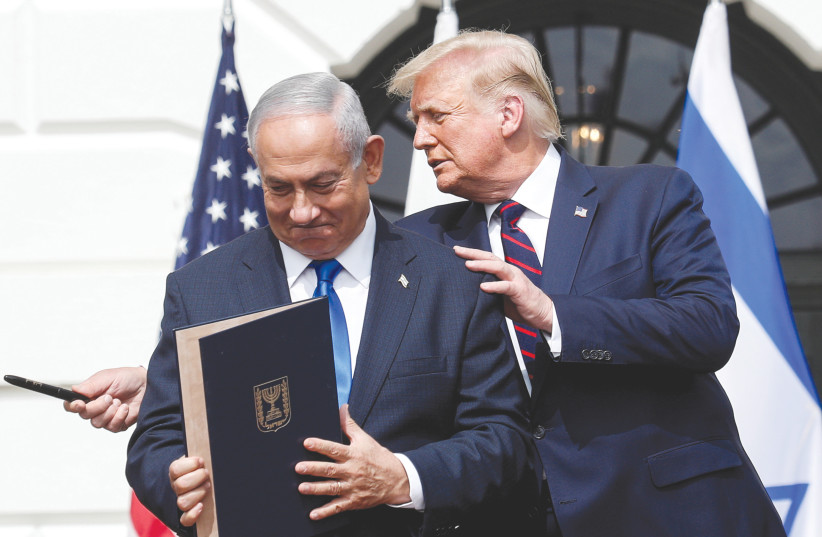
Har-Zvi also discussed Trump’s potential strategy toward Israel and Prime Minister Benjamin Netanyahu: “Trump will likely push hard to advance normalization efforts from the outset and may pressure Netanyahu to be more flexible in meeting the demands of Saudi Crown Prince Mohammed bin Salman—particularly on ending the war in Gaza and signaling a political horizon for the Palestinians.”
The Iran Question
On Iran, Har-Zvi suggested that Trump’s preferred strategy would involve negotiating a “nuclear deal 2.0” designed to prevent Tehran from developing nuclear weapons. “To achieve this, Trump may adopt a ‘maximum pressure’ approach, threatening severe economic sanctions and possibly hinting at military action against Iran’s nuclear sites to show the consequences of rejecting a new agreement.” However, Har-Zvi noted a crucial question: “Will Trump insist on a comprehensive deal that fully blocks Iran’s nuclear ambitions, or will he compromise to secure an agreement, recognizing that failure could lead to an escalation in the Israel-Iran conflict?”
In closing, Har-Zvi emphasized that “even before taking office, Trump is already influencing regional dynamics, particularly with the potential for a new hostage deal. His policies could reshape both the global and Middle Eastern landscapes. On one hand, Trump appears ready to put all options on the table. On the other, he seems intent on rebuilding US economic and military strength while avoiding new wars. Trump’s first term showed he is unafraid to pressure US allies to achieve his objectives. Israel must consider this as it formulates its policies moving forward.”


 END TIMES PROPHECY WATCH
Leave a comment