

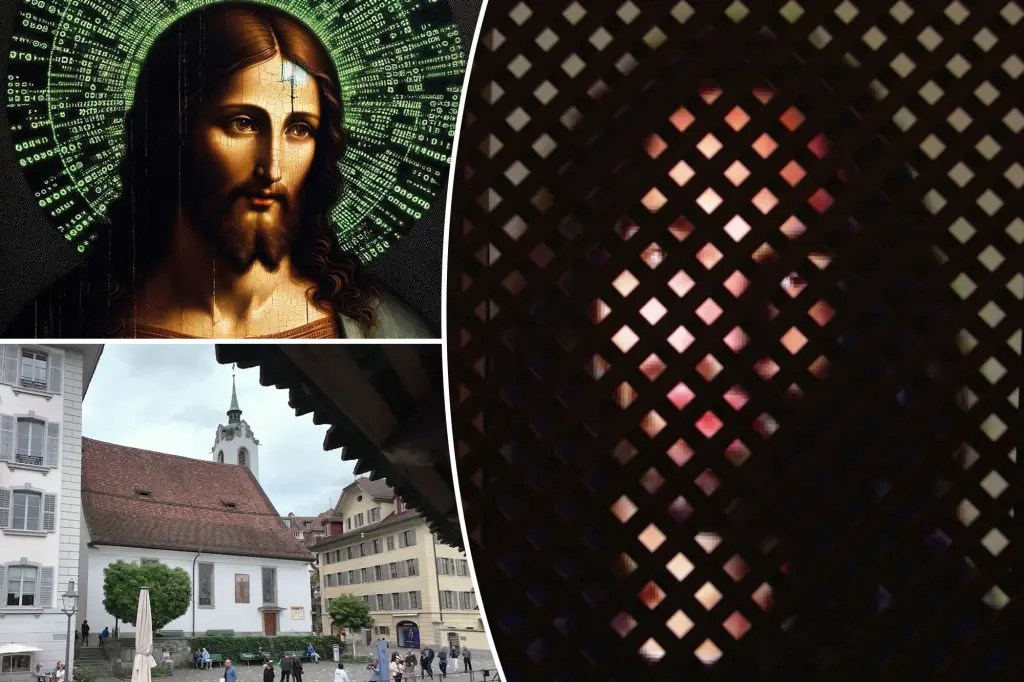
Would you trust an “AI Jesus” with your innermost thoughts and troubles?
Researchers and religious leaders on Wednesday released findings from a two-month experiment through art in a Catholic chapel in Switzerland, where an avatar of “Jesus” on a computer screen — tucked into a confessional — took questions by visitors on faith, morality and modern-day woes, and offered responses based on Scripture.
The idea, said the chapel’s theological assistant, was to recognize the growing importance of artificial intelligence in human lives, even when it comes to religion, and explore the limits of human trust in a machine.
After the two-month run of the “Deus in Machina” exhibit at Peter’s Chapel starting in late August, some 900 conversations from visitors –- some came more than once –- were transcribed anonymously. Those behind the project said it was largely a success: Visitors often came out moved or deep in thought, and found it easy to use. A small sign invited visitors to enter a confessional -– chosen for its intimacy –- and below a lattice screen across which penitent believers would usually speak with a priest, a green light signaled the visitor’s turn to speak, and a red one came on when “AI Jesus” on a computer screen on the other side was responding.
Often, a lag time was needed to wait for the response – a testament to the technical complexities. After exiting, nearly 300 visitors filled out questionnaires that informed the report released Wednesday. Of love, war, suffering and solitude
Philipp Haslbauer, an IT specialist at the Lucerne University of Applied Sciences and Arts who pulled together the technical side of the project, said the AI responsible for taking the role of “AI Jesus” and generating responses was GPT-4o by OpenAI, and an open-source version of the company’s Whisper was used for speech comprehension.
An AI video generator from Heygen was used to produce voice and video from a real person, he said. Haslbauer said no specific safeguards were used “because we observed GPT-4o to respond fairly well to controversial topics.”
Visitors broached many topics, including true love, the afterlife, feelings of solitude, war and suffering in the world, the existence of God, plus issues like sexual abuse cases in the Catholic Church or its position on homosexuality.
Most visitors described themselves as Christians, though agnostics, atheists, Muslims, Buddhists and Taoists took part too, according to a recap of the project released by the Catholic parish of Lucerne.
About one-third were German speakers, but “AI Jesus” — which is conversant in about 100 languages — also had conversations in languages like Chinese, English, French, Hungarian, Italian, Russian and Spanish. ‘Work of the Devil’?
“What was really interesting (was) to see that the people really talked with him in a serious way. They didn’t come to make jokes,” said chapel theologian Marco Schmid, who spearheaded the project. Most visitors were aged 40 to 70, and more Catholics respondents found the experience stimulating than did Protestants, the report showed.
Schmid was quick to point out that the “AI Jesus” – billed as a “Jesus-like” persona – was an artistic experiment to get people thinking about the intersection between the digital and the divine, not substitute for human interaction or sacramental confessions with a priest, nor was it intended to save pastoral resources.
“For the people it was clear that it was a computer … It was clear it was not a confession,” Schmid said. “He wasn’t programmed to give absolutions or prayers. At the end, it was more summary of the conversation.”
The Catholic Church from the Vatican on down has been wrestling with the challenges –- and possible opportunities -– presented by the explosion in public interest in AI since generative artificial intelligence captured the world’s attention two years ago when OpenAI’s ChatGPT made its debut.
The Vatican has appointed a friar from a medieval Franciscan order as its top expert on AI, and a Lutheran church in Bavaria served up sermons delivered by a chatbot last year. Pope Francis, in his annual peace message for this year, pushed for an international treaty to ensure the ethical use of AI technology.


 END TIMES PROPHECY WATCH
Leave a comment