

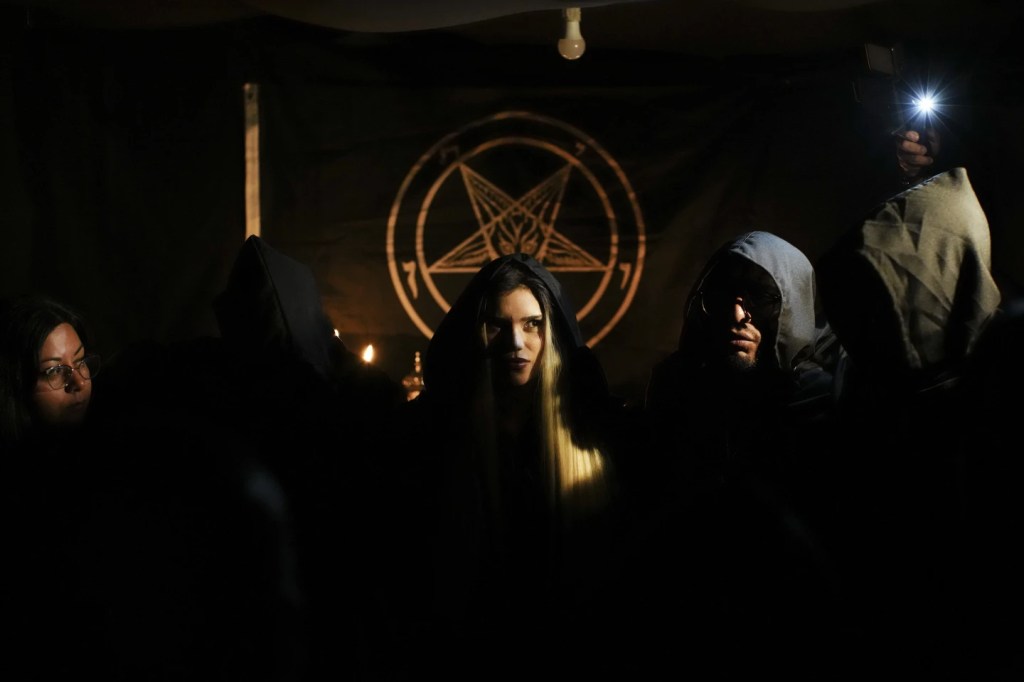
It’s Friday night in Downtown Santiago, the capital of Chile, and a group of 15 people gather around a table, sharing a bottle of wine as the smell of tobacco and incense fill the air. Black candles burn on top of an altar decorated with chalices and knives. The members of the Temple of Satan are about to start a ritual. Five years after the Satanic Temple of the United States made headlines — and unleashed a wave of panic — when it was designated a church, a similar organization in Chile, a conservative country where half of its population of 18 million identifies as Catholic, is asking the government to recognize them legally as a religious association.
Scholars, believers and residents consulted by The Associated Press note that Chile, where a long-lasting tradition of Catholicism has played a leading role in public discussions, is experiencing a crisis of faith, following revelations of multiple sexual abuse scandals within the Catholic church over the years. “These types of organizations now feel that they have greater support to challenge what was virtually impossible before,” said Luis Bahamondes, a professor at the Center for Judaic Studies at the University of Chile. And that’s because, “until very recently, the Catholic Church enjoyed an unprecedented power. It had an opinion on everything: politics, economics, geopolitics, sexuality and education.”
Despite its name, The Temple of Satan: Satanists and Luciferians of Chile does not embark on sacrifices nor asks its congregants to worship the devil. Among its 100 members are people who work as publicists, firefighters, police officers, lawyers and psychologists, who have found in the organization a way to defy moral norms, dogmas and religious impositions. While they embrace the term Satanist, they don’t revere or believe in Satan. Instead, they worship rationality, individualism, pleasure and the mundane life.
Rather than gods, they praise humankind.
“You are the owner of your present and future, there is no God that makes decisions for you,” said Haborym, a spokesperson for the group, during a walk through tombs and mausoleums at the General Cemetery of Santiago. He notes that the figure of Satan is purely symbolic and their rituals are performed “to bring out the emotions and leave the intellect aside.”


 END TIMES PROPHECY WATCH
Leave a comment