

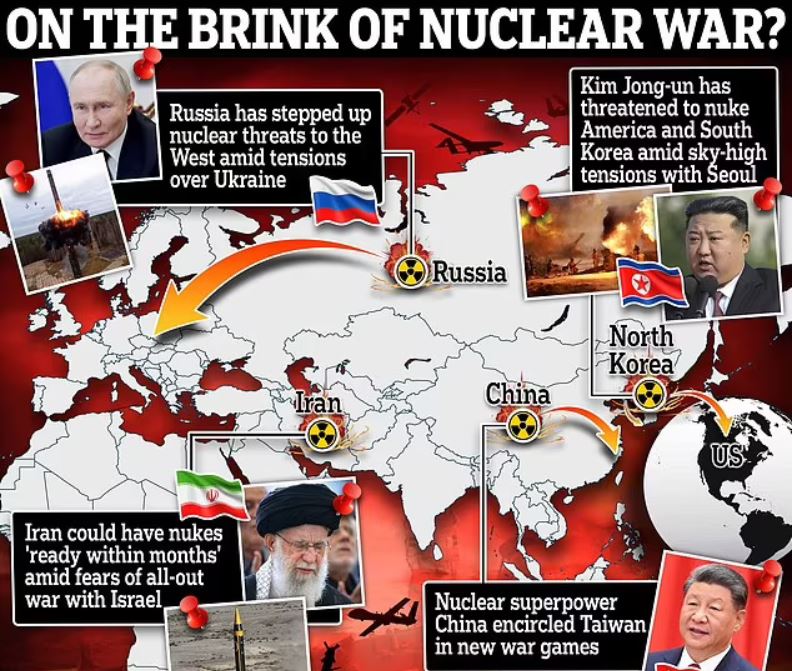
As conflict rises to frightening levels across the globe, the threat of all-out nuclear war has become even more prominent.
China‘s hostility towards Taiwan, Iran‘s nuclear ambitions, a raging North Korea, and Russia’s invasion of Ukraine all come together to suggest the world may never have been closer to Armageddon than right now.
Since the end of WWII, nuclear-armed states have engaged in a policy of deterrence, which is based on the idea that if warring states were to launch major nuclear strikes it would lead to mutually assured destruction. But this has not stopped countries embroiled in conflict from launching threats and displaying shows of strength regarding their nuclear capabilities.
MailOnline has taken a look into the four nuclear flashpoints across the planet and how they are forcing us to the brink of WWIII and Armageddon. Russia and the West
Just last month, Russia’s tyrant leader Vladimir Putin said the country would consider an attack from a non-nuclear state that was backed by a nuclear-armed one to be a ‘joint attack’ in what could be construed as a threat to use nuclear weapons in the war in Ukraine.
Putin, 71, declared his government was was considering changing the rules and regulations around Russia and its use of its nuclear arsenal even though war-torn Ukraine is a non-nuclear state that relies on military support from the US and other nuclear-armed countries.
Responding to Putin’s remarks, Ukrainian President Volodymyr Zelensky‘s chief of staff Andriy Yermak said Russia ‘no longer has anything other than nuclear blackmail to intimidate the world’.
Putin has threatened the use of nuclear weapons in the past, but even Russia’s allies including China have called for calm with reports Chinese President Xi Jinping warning the dictator against using nuclear arms.
The threats have always failed to materialise, and Russia has continued its bombardment of Ukraine without using its nuclear arsenal.
In the early days of Russia’s full-scale invasion of Ukraine, Putin frequently invoked Moscow’s nuclear arsenal, the world’s biggest, repeatedly pledging to use all means necessary to defend Russia. He later seemed to moderate his rhetoric, but officials close to the Russian president have recently warned Nato countries they risked provoking nuclear war if they gave the green light for Ukraine to use long-range weapons.
But last month, Putin announced the radical expansion of the nuclear doctrine that would ‘clearly set the conditions for Russia to transition to using nuclear weapons’ – and said such scenarios included conventional missile strikes against Moscow.
He also said that Russia would consider such a ‘possibility’ of using nuclear weapons if it detected the beginning of a massive launch of missiles, aircraft, and drones into its territory.
The country’s nuclear arms were ‘the most important guarantee of security of our state and its citizens’, the Kremlin leader said.
Putin claimed the more was a direct response to discussions in the US and UK about allowing Ukraine to strike deep into Russian territory with Western-supplied long-range conventional missiles.
The leader earlier said in a speech to launch his ‘special military operation’ in Ukraine that Russia is a leading nuclear power ‘and possesses certain advantages in some of the newest types of weaponry.
‘In this regard, no one should have any doubts that a direct attack on our country will lead to defeat and horrible consequences for any potential aggressor.’ He later added: ‘Whoever tries to hinder us, or threaten our country or our people, should know that Russia’s response will be immediate and will lead you to consequences that you have never faced in your history.’
Putin declared that any attempt to use nuclear weapons on Russia would provoke a split-second response with hundreds of nuclear missiles that no enemy could survive.
‘I think no person of sound mind and clear memory would think of using nuclear weapons against Russia,’ he said, before declaring that his forces had tested and will place on combat duty their latest nuclear-capable weapons, the Burevestnik cruise missile and Sarmat intercontinental ballistic missile.
Pavel Podvig, a senior researcher at the United Nations Institute for Disarmament Research (UNIDIR), is widely considered to be the world’s leading Western expert on Russia’s nuclear weapons and last month warned: ‘If there were to be some kind of a massive launch — or several [Russian] missiles have been launched — then it’s pretty much impossible to guarantee that everything will be intercepted’.
Russia boasts a fearsome nuclear arsenal with more atomic weapons than any other country.
It is said to have some 5,800 nuclear warheads, 1500 of which are operational and ready for deployment with Putin declaring in March that his nation was ready for the eventuality of a nuclear war ‘from a military-technical point of view’.
North Korea, South Korea, and the US
North Korea regularly issues fiery, blistering rhetoric as the ties between the two Koreas remain tense since a US-led diplomacy on ending North Korea’s nuclear programme fell apart in 2019.
North Korea has since pushed hard to expand its nuclear arsenal and repeatedly threatened to attack South Korea and the US with its nuclear weapons. South Korea has no nuclear weapons
North Korea has argued it was forced to pursue nuclear weapons to deal with U.S.-led nuclear threats.
But experts say it’s unlikely for North Korea to launch a full-blown attack because its military is outpaced by the combined US and South Korean forces.
In July, US President Joe Biden and South Korean President Yoon Suk Yeol authorised the signing of joint nuclear deterrence guidelines as part of efforts to enhance their capabilities to cope with North Korea’s growing nuclear arsenal.


 END TIMES PROPHECY WATCH
Leave a comment