

Almost a year on from the dark events of Hamas‘ October 7 attacks on Israel, the Middle East appears on the edge of catastrophe.
The last 12 months have seen Israel’s IDF reduce huge swathes of Gaza to dismantle Hamas and fend off skirmishes from Hezbollah at its northern border, all while facing endless threats of retribution and destruction from arch-enemy Iran.
But regional tensions are now approaching boiling point, with Israel having launched a ground incursion into Lebanon and embarked on a brutal campaign of incessant airstrikes that last week assassinated Hezbollah leader Hassan Nasrallah. Earlier this week, Hezbollah’s backers in Tehran unleashed some 180 ballistic missiles at Israel, some of which successfully penetrated air defence systems and rained down across the Jewish state.
Now Israel appears set to strike back, with Iran’s nuclear, oil and gas facilities said to be in the IDF’s crosshairs.
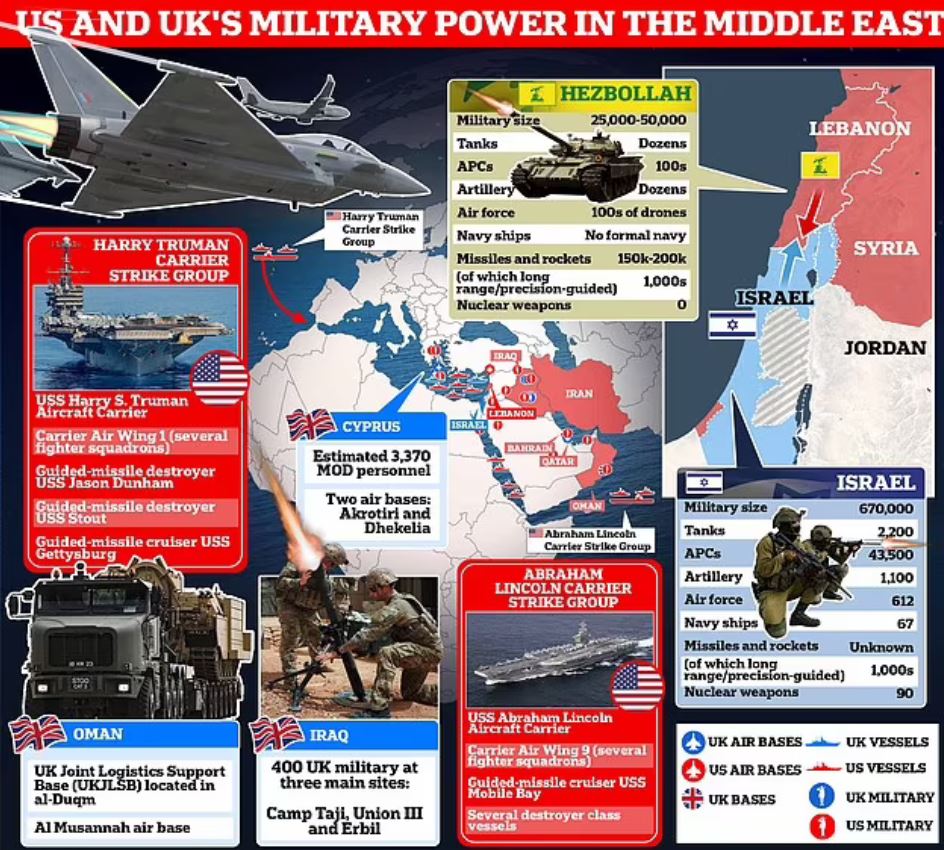
Amid the chaos, Western powers have been left with no choice but to ramp up their military presence in the region in the hopes of deterring the Islamic Republic – and reassuring Tel Aviv that it will be supported by its allies should the conflict spiral into all-out war.
Here, MailOnline breaks down how the US and UK are piling troops, ships and aircraft into the Middle East and examines how their forces would take on the might of Iran and its Axis of Resistance. Even before Hamas launched its ruthless attack on Israeli civilians on October 7, 2023, Western powers were already well positioned in the Middle East.
The US military had more than 30,000 troops stationed at various bases in a dozen countries, including some 13,000 in Qatar, 7,000 in Bahrain, at least 3,000 each in Saudi Arabia, Jordan and Kuwait, 2,500 in Iraq, and about 2,500 in Turkey – not to mention a handful of soldiers in Syria.
Another 2,000 US Marines with the 26th Marine Expeditionary Unit had also just arrived in Kuwait for an exercise when Hamas and Palestinian militants stormed across the border.
Beyond the sheer manpower, the US Navy maintained a constant presence with ships deployed throughout the region’s waters, many of which were tasked with protecting defenceless merchant shipping vessels in the Red Sea once Yemen’s Houthi rebels began launching strikes.
They were also tasked with helping Israel to shoot down Iranian missiles and drones fired by Iran in April, before intervening again on Tuesday amid Tehran’s latest barrage.
But within weeks of Hamas attacks and Israel’s retaliatory strikes in Gaza, Washington assigned another 10,000 troops to the Middle East, including a rapid response force comprised of 2,000 Army and Air Force personnel.
Two aircraft carriers, including the world’s largest – the USS Gerald R. Ford – were sent to the eastern Mediterranean, and the West’s aerial threat was upgraded with a slew of F-15 and F-16 fighter jet squadrons deployed to double the number available in the Persian Gulf.
The Gerald R. Ford alone has a 5,000-strong crew and carries some 90 warplanes, including F-18 Super Hornet jets, F-35 stealth multirole combat aircraft and A-10 Warthog ‘tank buster’ air-to-ground support platforms.
The UK meanwhile operates a pair of RAF airbases in Cyprus and has a smattering of MoD personnel stationed at military bases in Oman, Bahrain, Qatar and Iraq.
RAF Typhoons earlier this year launched from the Akrotiri base in Cyprus to conduct strikes against military targets in Yemen and have been involved in preventing Houthi drone attacks on Red Sea vessels.
The Royal Navy also has two warships stationed in the Eastern Mediterranean and more than 4,000 personnel stationed at bases throughout the Middle East.
Amid Israel’s renewed offensive on Hezbollah in Lebanon and Iran’s missile barrage of its regional foe, the number of Western troops in the region has been bumped up yet again.


 END TIMES PROPHECY WATCH
Leave a comment