

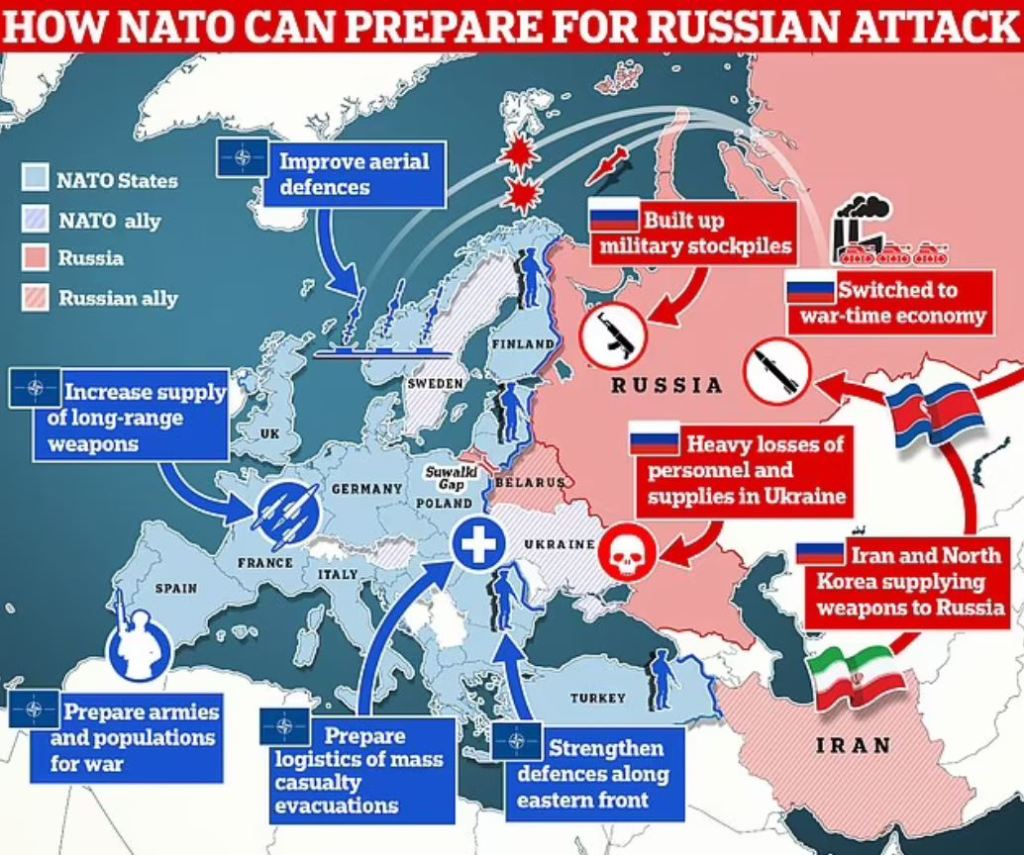
NATO is developing mass evacuation and rescue plans in case of a future war with Russia, a senior general has declared.
Lieutenant-General Alexander Sollfrank, the head of NATO’s logistics command, confirmed this week the security bloc is working to ensure it has the operational capability to extract large numbers of wounded troops from the front lines.
The German general warned that, unlike allies’ experience in Afghanistan and Iraq, an all-out war with Russia would likely see NATO incur heavy losses across a huge battlefield. What’s more, Russia’s air force and its vaunted rocket and missile stockpiles mean that medical evacuations via aircraft would be too risky – a factor that could force NATO’s troops to operate ‘hospital trains’ to extract the wounded en masse.
‘The challenge will be to swiftly ensure high-quality care for, in the worst case, a great number of wounded,’ he said.
Sollfrank’s warning comes as the German military says it expects Russia to be able to attack a NATO country as soon as 2029. Sollfrank runs NATO’s Joint Support and Enabling Command (JSEC), tasked with coordinating the swift movement of troops and tanks across Europe as well as logistical preparations such as the storage of munitions on NATO’s eastern flank.
But since Vladimir Putin sent his troops streaming across the border with Ukraine in February 2022, relations between Russia and the West have plunged to lows not seen since the Cuban Missile Crisis.
That forced Sollfrank and JSEC to confront the possibility of a major land war in Europe, and the unit began planning its approach to medical evacuations accordingly.
Should a conflict with Russia arise, wounded troops will need to be transported over a larger distance than in other wars of recent years, Sollfrank said.
Russian air defences and jets mean medical evacuation flights would be placed under a much greater threat unlike anything they had faced before from insurgents in Afghanistan or Iraq.
Sollfrank reasoned that a massive network of rail and road evacuation vehicles would need to be deployed and said NATO forces would have to be supported by specially designed trains that can transport more casualties at the same time than aircraft.
‘Air superiority will have to be achieved in the first place. It will require time to succeed over the entire length and depth of the front line,’ Sollfrank said in an interview with Reuters.
‘For planning reasons, all options to take a great number of wounded to medical installations need to be considered, which includes trains but potentially also buses.’
Differing medical regulations between countries are another hurdle to overcome, Sollfrank said.
A ‘military medical Schengen’, akin to the political Schengen zone that allows free movement within most of the European Union, could be a solution.
It could entail an area of free passage for sensitive medications such as narcotics or strong painkillers, which would be needed to treat wounded troops but whose cross-border transport is regulated.
But the planning for medical evacuations is just one part of a much broader drive by NATO to overhaul and boost its ability to deter and defend against any Russian assault.
This year, the security bloc launched its greatest campaign of military drills since the Cold War.
The Steadfast Defender 2024 suite of exercises saw some 90,000 troops from more than 30 allied and partner countries test their collective capabilities in land, air, sea, and cyber conflict theatres.


 END TIMES PROPHECY WATCH
Leave a comment