

‘While war is not inevitable, US will defend Israel if it were attacked,’ Pentagon vows amid fears of Iranian attack; Biden sends military reinforcements to region, including stealth jets, amphibious assault ship and carrier near Iran; Red Sea also covered
“The changes in our force posture will enhance our already extensive capabilities in the region,” Defense Secretary Lloyd Austin said after speaking with Israeli Defense Minister Yoav Gallant about Washington’s troop reinforcements. “We are prepared to act on short notice to address emerging threats to our security, our partners, and our interests.”
Pentagon Press Secretary Maj. Gen. Pat Ryder noted that Austin assured Gallant that “while war is not inevitable and de-escalation is the preferred course of action, the U.S. will defend Israel if it were attacked.”
The last time Israel was attacked by Iran and its allies, on the night of April 13-14, over 300 missiles and drones were launched from multiple directions. According to reports, the U.S. Air Force alone helped intercept 80 of the drones.
The IDF said that almost all the munitions launched during that attack were intercepted, with only five breaching the defense shield of Israel and its regional and international coalition allies. However, there is now concern that Iran or Hezbollah might attempt a broader, more complex assault that could pose a greater challenge to these defense capabilities. Although reports suggest that Iran is deliberating over its response, with voices in Tehran warning against the repercussions of a direct, extensive attack that could ignite a regional war, the ultimate decision rests with Iran’s Supreme Leader Ayatollah Ali Khamenei, a hardliner in the Islamic Republic. Consequently, Israel, the U.S. and their allies are taking no risks and are preparing for the worst-case scenario.
Below is a summary of the newly deployed U.S. forces in the region, according to various reports, though it should be noted that for obvious reasons, the U.S. does not disclose the exact locations of its forces, which have recently been targeted by pro-Iranian militias.
The Pentagon’s latest announcement regarding troop reinforcements, deemed significant by military analysts for deterring Iran, involved the deployment of F-22 Raptor fighter jets. The announcement about their arrival in the U.S. Central Command operating theater did not specify the number of aircraft or the base they were sent to, noting only that the aim is to help prevent a regional war with Iran or its proxies.
American officials told Air & Space Forces Magazine that the deployed F-22 squadron consists of approximately 12 jets from a base in Alaska. The officials noted that the jets covered over 10,000 kilometers, stopping halfway at a UK base and relying on aerial refueling. They crossed the Mediterranean Sea and landed at a base in the region—whose location remains classified. The Pentagon told the magazine that the positioning of the fighter jets in the Middle East would remain confidential to ensure troop safety. The magazine reports that the F-22s are now the most advanced fighter jets in the region. These fifth-generation fighters were developed for air superiority, and the Pentagon emphasizes that they can also support defensive missions.
“They can be a very invaluable defensive platform,” said Deputy Pentagon Press Secretary Sabrina Singh. “They add maneuverability [and] additional systems that allow the commander to have more versatile options. And I think it sends a very clear signal to the region that we want to see tensions de-escalate. And it sends a really powerful message of deterrence.”
According to Air & Space Forces Magazine, the U.S. Air Force already has fighter jets from three other models in the region: F-15E fighters from the 335th Squadron based in North Carolina, which assisted in intercepting drones during the April attack; F-16s from the 510th Squadron deployed from a base in Italy; and A-10 jets from the 107th Squadron based in Michigan. The magazine notes that while the A-10s have limited air-to-air capabilities, likely referring to drone interception, they can pose a threat to ground and naval forces.
Navy squadron moved to land base ‘closer to Israel’
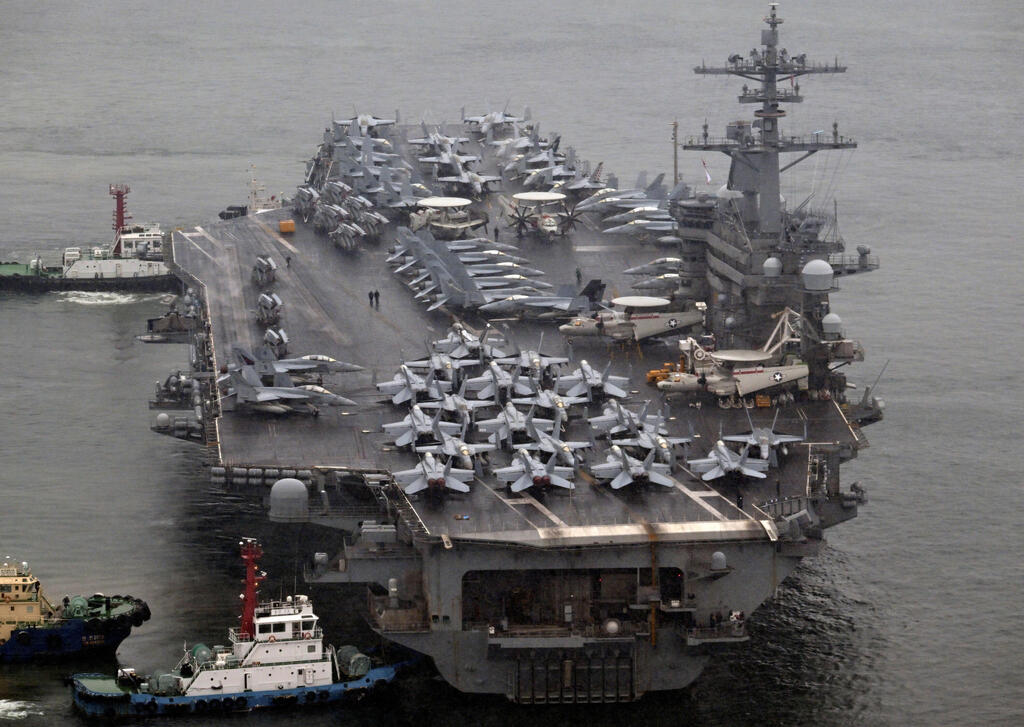
The U.S. Navy also has air power, with the magazine reporting that about 12 F/A-18 Super Hornets—normally stationed on the aircraft carrier Theodore Roosevelt—were relocated amid tensions to an air base in the region, closer to Israel and U.S. forces operating in Iraq, Syria and Jordan. However, their exact location remains confidential.
The report suggests that moving the squadron to a land base in the region allows for quicker operations, as the Roosevelt is currently much farther away, in the Gulf of Oman. Another advantage is that while carrier-based air operations are typically limited to 12 hours a day, a land base allows for 24/7 activity.


 END TIMES PROPHECY WATCH
Leave a comment