

As he interviewed former President Donald Trump in front of a town hall audience in early December, Fox News host Sean Hannity tossed out what seemed an obvious softball. Could Mr. Trump just reassure America, once and for all, that he “would never abuse power as retribution against anybody?”
Mr. Trump, however, had other plans.
“Except for Day 1,” he said, straight-faced and staring at Mr. Hannity. He paused for the briefest of beats, and then turned to the audience with a glimmer of a smile.
“He’s going crazy,” said the former president, pointing at Mr. Hannity as the audience chuckled.
“He says, ‘You’re not going to be a dictator, are you?’” Mr. Trump continued. “I say no, no, except for Day 1. We’re closing the border, and we’re drilling, drilling, drilling. After that – I’m not a dictator, OK.”
As the Iowa caucuses and the official beginning of the 2024 election cycle arrive, the question of whether a second Trump term would result in the collapse of American democracy as we know it has gripped much of official Washington and U.S. pundits and political insiders.
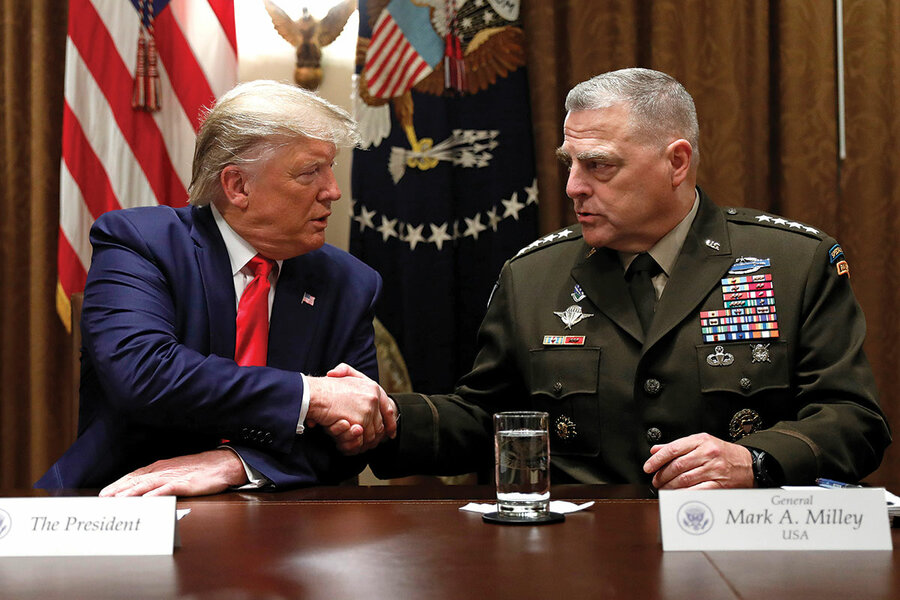
Mr. Trump’s own words have fed this narrative. Among other things, he’s dehumanized political opponents as “vermin” who need to be exterminated, proposed that shoplifters be shot, said immigrants are “poisoning the blood of our country,” and suggested that former Chairman of the Joint Chiefs of Staff Mark Milley should be executed after a trial for treason.
His critics say those words should be considered against the background of past actions. They point to what the former president actually did in the wake of the 2020 election, when he falsely insisted the election had been stolen despite lack of evidence and numerous court rulings against him. He pushed state officials to overturn their results, tried to shut down the Electoral College vote count in Congress, and considered seizing voting machines with the U.S. military.
Former GOP Rep. Liz Cheney calls Mr. Trump the “most dangerous man ever to inhabit the Oval Office” in her new memoir. Noted neoconservative scholar Robert Kagan wrote a lengthy piece in The Washington Post arguing a Trump dictatorship is “increasingly inevitable.” The Atlantic has published a special issue devoted almost entirely to its dire vision of a second Trump White House.
Tomorrow, President Joe Biden will give a speech in Valley Forge, Pennsylvania, marking the third anniversary of the Jan. 6 riot at the U.S. Capitol and warning democracy itself is on the ballot.
Meanwhile, Mr. Trump has reacted as he often has in similar situations, using the uproar to create a political spectacle, with himself as the attention-grabbing center.
As in his answer to Mr. Hannity, he has at times dealt with the subject teasingly, dangling the prospect of authoritarian moves yet then backing off, as if it were all a joke.
At other times, particularly at his political rallies or on Truth Social posts, he can be much darker, as when he called for the “termination” of parts of the Constitution over his false claim that the 2020 election was stolen.
So has America’s government “by the people” truly reached a turning point? Mr. Trump’s defenders often scoff that his critics have “Trump derangement syndrome” and overreact to his political antics. Many presidents, up to and including Mr. Trump’s predecessors George W. Bush and Barack Obama, have been called dictatorial, anti-democratic, and worse.
Yet in Mr. Trump’s first term, experienced officials such as chief of staff John Kelly blocked many of his most reckless proposals. The Trump team is planning for any second term to be staffed with loyalists who may not act the same way. The former president’s impeachments, indictments, and criminal and civil trials have already written a new chapter in the history of the United States. The book is open. Where will the story go now?
“It’s important not to overstate the threat that Trump poses to democracy, but it’s also important not to understate it,” says Stephen Vladeck, a professor at the University of Texas at Austin School of Law.
Past as prelude?
Mr. Trump is not a surefire White House winner in 2024. One of his GOP opponents might rise and defeat him in the primaries; efforts in the states to keep him off the ballot over insurrectionist charges could conceivably bear fruit; a criminal conviction in federal court might peel away a crucial portion of voter support.


 END TIMES PROPHECY WATCH
Leave a comment